



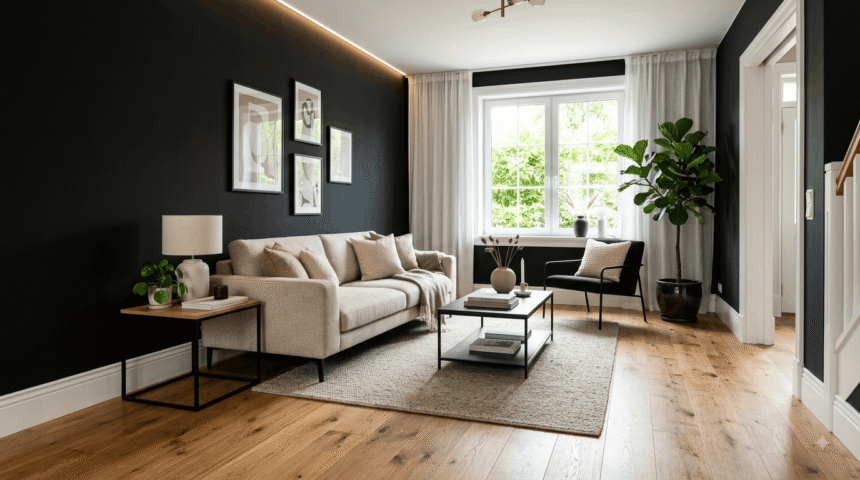
Modern black walls white trim ideas can give a room a dramatic, architectural look without requiring a complicated color palette. The strong contrast between a dark wall and crisp trim can highlight windows, doors, molding, fireplaces and other structural details while creating a clean contemporary backdrop.
The key is balance. Black paint absorbs more light than lighter colors, so the result depends heavily on the room’s natural light, artificial lighting, furniture, flooring and the particular undertone of both the black and white. Paint manufacturers also recommend evaluating colors in the actual room because lighting and room orientation can significantly change how a color appears.
Below are 10 practical ways to use this combination, along with guidance for choosing the right black, selecting white trim, avoiding common mistakes and making the finished room feel sophisticated rather than overly dark.
Why Black Walls With White Trim Work So Well
Black and white create one of the strongest contrasts available in interior design. That contrast naturally draws attention to architectural lines and makes details such as baseboards, window casings and door frames more visible.
The combination can also be adapted to different decorating styles. It can look minimalist with simple furniture, traditional with detailed molding, industrial with metal accents, or warmer and softer when combined with wood and textured fabrics. Architectural Digest similarly highlights the flexibility of black-and-white interiors, noting that the palette can be interpreted in both modern and classic ways.

There is another advantage: you do not necessarily have to paint every wall black. A single feature wall can create much of the desired effect while preserving more brightness throughout the room.
1. Black Accent Wall With Bright White Trim
One of the easiest modern black walls white trim ideas is to start with a single accent wall.
Choose the wall behind a bed, sofa, fireplace or television and use a deep black or near-black shade. Keep the surrounding walls lighter and use white on the baseboards, door frames and window trim.

This approach works particularly well if you are nervous about committing an entire room to black. The dark wall becomes the visual anchor while the white architectural elements provide definition.
Best for:
- Living rooms
- Bedrooms
- Home offices
- Dining rooms
- Media rooms
For a particularly modern result, keep the furniture relatively simple and introduce one or two contrasting materials such as natural wood, brushed metal or linen.
2. Black Walls With Classic White Crown Molding
Black does not have to mean minimalist.
If your home has crown molding, panel molding or decorative trim, painting the walls black while keeping the architectural details white can create a dramatic contemporary interpretation of traditional architecture.
The white molding becomes almost graphic against the dark background. This can be especially effective in dining rooms, entryways and older homes where existing architectural details deserve attention.

Rather than removing traditional features to make a home look modern, this approach uses contrast to give those features a more current appearance.
3. Black Bedroom Walls With White Baseboards
Bedrooms are particularly suitable for dark colors because the goal is not always to make the space feel bright and expansive.
A black bedroom can feel intimate and calm when it is balanced with white baseboards, light bedding and carefully selected lighting. Benjamin Moore also notes that dark colors can work effectively in bedrooms, particularly when balanced with lighter elements and appropriate surrounding tones.
For a modern bedroom:
- Paint the main walls a deep black or charcoal.
- Keep baseboards white.
- Use white, cream or light-gray bedding.
- Add warm wood furniture.
- Use bedside lamps instead of relying entirely on overhead lighting.
- Consider curtains in linen, beige or soft gray.
The goal is not to make every object black and white. Natural textures prevent the room from feeling flat.
4. Black Living Room Walls With White Window Trim
Large windows provide an excellent opportunity for this color scheme.
Paint the walls black and leave the window casings white. The white trim creates a frame around the windows, while the darker wall makes the outside view visually prominent.
This works especially well in rooms with substantial daylight. Dark paint can absorb light, but strong natural light can help balance the effect. Sherwin-Williams recommends considering natural light, room size and surrounding surfaces before selecting darker colors.
For furniture, consider:
- Light-colored sofas
- Natural oak or walnut
- Cream rugs
- Green plants
- Brass or bronze accents
- White artwork frames
This keeps the black wall from dominating every element of the room.
5. Black Kitchen Walls With White Cabinets and Trim
A kitchen can use the black-and-white combination without making the entire space dark.
One effective arrangement is to use black on selected walls while keeping cabinets, trim and larger surfaces white. The result provides contrast while maintaining a bright working environment.
White cabinetry against a dark wall can also make the cabinet profile more noticeable. Add wood cutting boards, natural stools or warm metallic hardware to soften the contrast.
If the kitchen has limited natural light, consider charcoal or very dark gray rather than a completely neutral black. Sherwin-Williams notes that dark neutrals can create drama but that lower-light rooms require careful attention to LRV and lighting.
6. Black Home Office With White Door and Window Frames
A home office can benefit from a darker backdrop because it creates a visually focused environment.
Paint the walls black while keeping the door, window trim and baseboards white. Place a light wood desk against the wall and add a desk lamp with warm illumination.
This combination can look especially polished with minimal decoration.
Try using:
- White shelving
- Oak or walnut furniture
- Black metal lighting
- Cream textiles
- A few framed prints
- Green plants
Avoid covering every available surface with accessories. The strength of the black-and-white scheme comes partly from its simplicity.
7. Black Wainscoting With White Trim Details
You do not have to choose between an entirely black wall and an entirely white wall.
Wainscoting offers a third option.
Paint the upper wall black while using white for the molding and selected lower panels. Alternatively, use black inside the panel areas and white around the frames.
This creates layers of contrast rather than one uninterrupted block of color.
It is particularly effective in:
- Dining rooms
- Hallways
- Entryways
- Powder rooms
- Bedrooms
A useful design principle is to let the architecture determine where the colors change. Instead of adding random horizontal lines, use existing molding, chair rails or panel divisions.
8. Black Fireplace Wall With White Surround
A fireplace naturally acts as a focal point, which makes it an excellent candidate for a black feature wall.
Paint the wall behind the fireplace black and keep the surrounding trim white. If the fireplace has a white mantel, the contrast becomes even stronger.
The technique works particularly well with simple fireplaces because the black wall gives the entire feature more visual weight.
For warmth, add:
- Natural wood
- Beige upholstery
- Textured rugs
- Cream-colored cushions
- Brass lighting
- Greenery
The result can feel sophisticated without becoming overly formal.
9. Black Hallway Walls With White Doors
Hallways are often overlooked when color schemes are planned, but they can be one of the best places to experiment with dramatic paint.
Painting a hallway black creates a tunnel-like visual effect, while white doors and trim provide repeated points of contrast.
This is particularly effective in homes with several white interior doors. The doors become architectural features rather than simply functional elements.
However, lighting should be considered carefully. A narrow hallway with little natural light can become excessively dark. Sherwin-Williams recommends considering the amount and direction of available light when selecting darker colors.
Wall sconces, ceiling fixtures and strategically positioned artwork can help break up the darkness.
10. Black Walls, White Trim and Warm Natural Materials
Perhaps the most versatile approach is to combine black walls and white trim with natural materials.
Black and white alone can sometimes feel stark. Wood, woven fabrics, stone and greenery introduce visual warmth without disrupting the overall palette.
Architectural Digest also highlights the value of natural elements in black-and-white interiors, demonstrating how the palette can be softened with materials and color accents.
A simple formula is:
Black walls + white trim + warm wood + soft textiles + natural greenery
This combination works in almost any room.
Comparing the 10 Black Wall and White Trim Ideas
| Idea | Best Room | Main Effect | Difficulty |
|---|---|---|---|
| Black accent wall | Living room | Strong focal point | Easy |
| Black with crown molding | Dining room | Dramatic architectural detail | Moderate |
| Black bedroom | Bedroom | Cozy and intimate | Easy |
| Black with window trim | Living room | Frames views | Moderate |
| Black kitchen wall | Kitchen | Contemporary contrast | Moderate |
| Black home office | Office | Focused atmosphere | Easy |
| Black wainscoting | Dining room | Layered detail | Moderate |
| Black fireplace wall | Living room | Strong focal point | Easy |
| Black hallway | Hallway | Bold architectural effect | Moderate |
| Black with natural materials | Any room | Warm modern style | Easy |
How to Choose the Right Black Paint
Not every black paint looks the same.
Some blacks have blue undertones. Others lean brown, green, charcoal or graphite. These differences can become surprisingly visible when the paint covers a large wall.
Room orientation matters too. North-facing rooms generally receive cooler, weaker natural light, while east- and west-facing rooms experience noticeable changes throughout the day.
Before committing to a color, test it directly in the room.
Paint a reasonably large sample and observe it:
- In morning light
- At midday
- In the evening
- Under your normal artificial lighting
- Next to the actual flooring
- Beside the intended white trim
Sherwin-Williams specifically recommends testing colors in the space rather than relying only on how they appear in a store or on a screen.
Choosing the Right White Trim
The phrase “white trim” sounds simple, but white paint also has undertones.
A cool, bright white can look crisp against a cool black. A warmer white can produce a softer and more sophisticated result when the black has brown or warm undertones.
Pure white can work particularly well in rooms with abundant natural light, while warmer whites may be more comfortable in spaces with limited or cooler light.
Do not choose the trim color independently of the wall color.
Put your black sample and white trim sample next to each other before making the final decision.
Should the Ceiling Stay White?
Usually, keeping the ceiling white is the safer choice if your goal is a crisp modern contrast.
A white ceiling reflects more light and creates a strong transition from the dark walls. It also keeps the classic black-and-white relationship clear.
However, a dark ceiling can be used intentionally when you want a more enclosed, dramatic atmosphere. Benjamin Moore and Sherwin-Williams both show that darker ceilings can contribute to a cozy, immersive room when the overall design is carefully balanced.
For most first-time projects, however, black walls with white trim and a white ceiling provide the easiest starting point.
How Lighting Changes Black Walls
Lighting may be the most overlooked factor in modern black walls white trim ideas.
A room that looks sophisticated during the afternoon can feel significantly darker at night if it has only one ceiling fixture.
Use layered lighting instead:
- Ambient lighting for general illumination.
- Task lighting for desks, reading areas and kitchen worktops.
- Accent lighting to highlight artwork, shelving or architectural details.
Warm lamps can make black walls feel softer and more inviting. Dimmers are also useful because they allow the room to shift between bright daytime functionality and a more atmospheric evening setting.
Common Mistakes to Avoid
Using the Same Black Everywhere
Painting every wall, ceiling, cabinet and piece of furniture black can eliminate the contrast that makes the design effective.
Black works best when its role is intentional.
Choosing Paint From a Small Screen
A digital color preview cannot reliably reproduce how a paint will look under your home’s specific lighting.
Always test a physical sample.
Ignoring Undertones
A blue-black wall beside a warm cream trim can create an unintended mismatch.
Check both colors together.
Using Only Cool White Lighting
Cool lighting can make a black-and-white room feel sterile. Warmer lighting often creates more depth and comfort.
Making Everything Black and White
The palette does not need to contain only two colors.
Wood, plants, stone, brass, bronze, beige and muted colors can make the room more visually comfortable.
Forgetting the Trim Finish
Trim receives more contact than walls, particularly around doors and baseboards. Sherwin-Williams recommends durable finishes such as semi-gloss or gloss for many trim applications.
A Useful Rule for Balancing Black and White
Instead of trying to achieve a mathematically perfect ratio, think about visual weight.
If the walls are black, allow lighter elements to occupy significant visual space through:
- White trim
- Light flooring
- Pale furniture
- Curtains
- Artwork
- Rugs
- Natural materials
This prevents the dark walls from becoming visually overwhelming.
The balance can also be adjusted according to the room. A small powder room may tolerate considerably more black than a family room that needs to feel bright throughout the day.
The Often-Missed Detail: Your Floor Matters
Wall color should not be chosen in isolation.
A black wall combined with dark flooring can create a much heavier result than the same wall with light oak or pale stone.
Sherwin-Williams specifically recommends considering the relationship between wall colors, flooring and available light because dark floors and dark walls together can make a low-light room feel excessively heavy.
If your floor is already dark, consider using:
- White or cream rugs
- Light upholstery
- Natural wood furniture
- Reflective accessories
- Pale curtains
These elements can restore visual balance.
Frequently Asked Questions
Are black walls with white trim still modern?
Yes. Black-and-white interiors continue to be used across contemporary, minimalist, traditional and transitional design. The combination is flexible because the furniture, materials, lighting and architectural details determine whether the final result feels modern, classic or industrial.
Do black walls make a room look smaller?
Dark colors can make surfaces visually appear closer, which may make a room feel more enclosed. However, that is not necessarily a disadvantage. In bedrooms, dining rooms and other spaces where coziness is desirable, the effect can be intentional. Room size, lighting, ceiling height and surrounding colors all influence the final result.
What color white is best with black walls?
There is no single best white. Cool whites generally create a sharper contrast, while warmer whites can produce a softer appearance. The correct choice depends on the undertones of the black paint and the room’s natural and artificial lighting.
Is black paint suitable for a small room?
Yes, but it should be used intentionally. A small room can become cozy and dramatic with dark walls, especially when supported by good lighting and lighter furniture. If the room has very little light, a softer charcoal may be easier to live with than an extremely deep black.
Should doors be black or white with black walls?
White doors create strong contrast and make the architecture stand out. Black doors create a more seamless, dramatic appearance. If your goal is the classic black-wall-white-trim look, white doors and frames provide the clearest definition.
What trim finish works best with black walls?
A durable semi-gloss or similar trim finish is commonly used because trim is exposed to more contact and cleaning than walls. The exact finish should depend on the paint system and the level of sheen you want.
Can black walls work in a north-facing room?
They can. North-facing rooms receive cooler, generally weaker natural light, so the black should be tested carefully. A black with warmer undertones can sometimes feel more comfortable than a very blue-black shade. Additional warm lighting can also help balance the room.
Final Takeaway
The best modern black walls white trim ideas are not simply about painting a wall black and adding white baseboards. The strongest results come from understanding contrast, natural light, undertones, flooring, furniture and lighting as one complete design.
A black accent wall is an easy starting point, while black wainscoting, fireplace walls, bedrooms, offices and hallways offer more distinctive approaches. White trim can then be used to emphasize windows, doors, molding and other architectural details.
Before buying a full can of paint, test both colors in the actual room and view them at different times of day. That small step can prevent a major design mistake and help you create a black-and-white interior that feels intentional, balanced and genuinely suited to your home.