


Line flowers are one of the simplest ways to give a floral arrangement height, direction, rhythm, and structure. Unlike large focal blooms that attract attention immediately, line flowers help establish the shape that the rest of the arrangement follows.
Line Flowers: Creative Flower Arrangement Ideas can be adapted to everything from a simple kitchen vase to a formal wedding centerpiece. Snapdragons, delphiniums, gladiolus, stock, liatris, and similar elongated blooms are commonly used because their stems naturally create vertical or sweeping lines.
The most effective arrangements do not simply place tall flowers in a vase. Height, spacing, color, movement, flower size, foliage, and the viewing angle all need to work together. Understanding the role of line flowers makes it much easier to create a display that looks intentional rather than crowded.
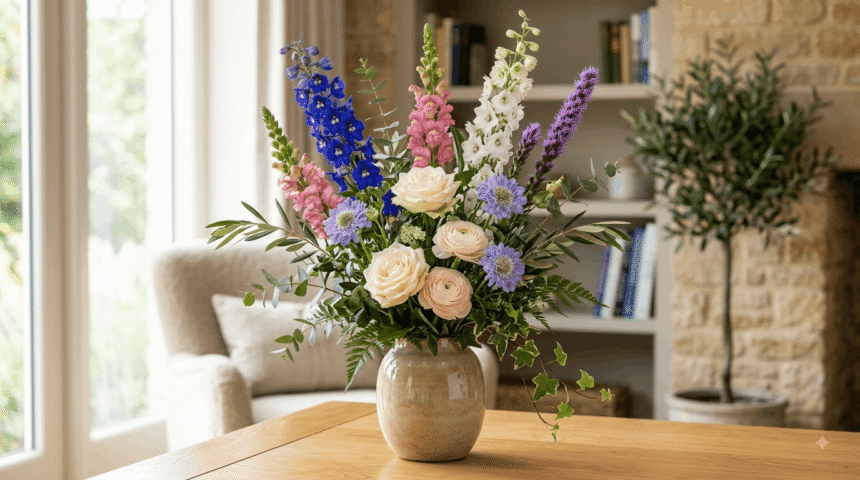
What Are Line Flowers?
Line flowers are flowers with elongated stems and blooms arranged along a noticeable vertical or directional axis. In floral design, they are primarily used to establish the outline, height, width, and movement of an arrangement.
Their shape naturally leads the viewer’s eye. A tall snapdragon can pull the eye upward, while a curved branch or arching stem can guide the eye sideways.
Common examples include:
- Snapdragons
- Delphiniums
- Gladiolus
- Liatris
- Stock
- Veronica
- Bells of Ireland
- Foxglove
- Cattails
- Pussy willow branches
Not every elongated plant is technically classified in exactly the same way by every designer. Floral design is partly practical and partly artistic, so a branch, foliage stem, or unusual flower can also perform a line function even when it is not traditionally categorized as a line flower.
Why Line Flowers Matter in Floral Design
A bouquet can contain beautiful flowers and still look flat. The problem is often a lack of structure.
Line flowers solve that problem by creating a framework before the larger flowers and fillers are added. They can determine whether an arrangement feels tall and formal, wide and relaxed, or asymmetrical and contemporary.
Three important functions are performed by line flowers:
1. They Establish Height
Tall stems can create a clear upper boundary for the arrangement. This is particularly useful in large rooms, entrance displays, wedding installations, and tall table arrangements.
2. They Create Movement
A straight line produces a different visual effect from a curved one. A vertical snapdragon can make an arrangement feel orderly, while an arching branch can make it appear more natural.
3. They Define the Overall Shape
Line flowers can establish a triangular, vertical, crescent, fan-shaped, or asymmetrical composition before the remaining flowers are positioned.
This is why floral designers often work with line elements early in the arrangement process.
Popular Line Flowers for Arrangements
Different line flowers produce noticeably different results. Choosing the right variety should therefore depend on the intended style rather than simply the flower’s availability.
| Line flower | Visual character | Best use |
|---|---|---|
| Snapdragons | Tall, colorful, structured | Traditional and garden arrangements |
| Delphinium | Tall and airy | Romantic and cottage-style designs |
| Gladiolus | Strong and dramatic | Large formal arrangements |
| Liatris | Narrow and textured | Modern and natural designs |
| Stock | Soft, dense vertical spike | Romantic bouquets |
| Veronica | Slim and delicate | Casual and airy arrangements |
| Bells of Ireland | Green and architectural | Contemporary designs |
| Foxglove | Tall and organic | Garden-inspired displays |
| Pussy willow | Curved and woody | Minimalist and seasonal designs |
The flowers listed above are examples rather than a fixed rulebook. The same stem can sometimes function differently depending on how it is cut and positioned.
10 Creative Line Flower Arrangement Ideas
1. Create a Tall Vertical Arrangement
The classic approach is to place several line flowers upright in a tall vase and surround them with shorter blooms.
Snapdragons or delphiniums can form the central vertical structure, while roses, carnations, chrysanthemums, or other mass flowers can be positioned lower down.
This style works particularly well on:
- Entry tables
- Fireplace mantels
- Dining tables
- Reception areas
- Large kitchen islands
Keep the tallest stems visually connected rather than placing every stem at exactly the same height. Small differences create a more natural rhythm.
2. Try an Asymmetrical Arrangement
Line flowers do not have to stand straight up.
Place one or two tall stems toward one side and allow shorter flowers to extend toward the opposite side. The result creates visual tension without making the arrangement feel unbalanced.
An asymmetrical design works especially well with curved stems, branches, or flowers with naturally irregular growth.
The key is to create visual balance rather than physical symmetry. A heavier group of flowers on one side can be balanced by height, color, or negative space on the other.
3. Combine Line Flowers With Large Focal Blooms
Line flowers become much more effective when their role is contrasted with larger flowers.
For example:
Delphinium + roses + baby’s breath + eucalyptus
The delphinium establishes height, the roses provide focal points, the filler flowers soften empty areas, and foliage creates additional texture.
This layered approach follows a common floral-design structure in which line, focal or form, mass, filler, and foliage elements perform different jobs.
4. Make a Minimalist Single-Flower Display
You do not always need a large bouquet.
A few gladiolus stems in a narrow, tall vase can create a striking minimalist display. The same approach can be used with snapdragons, liatris, or stock.
This style works because negative space becomes part of the design.
Instead of filling every gap, allow the stems to remain visible. The simplicity can make a small group of flowers look more deliberate.
5. Use Line Flowers in a Low Centerpiece
Line flowers are normally associated with height, but they can also be cut shorter and used to create horizontal movement.
Place stems at different angles in a low container. Add a few focal flowers near the center and allow selected stems to extend toward the edges.
This is useful for dining tables because the arrangement can remain visually interesting without creating a tall obstruction between people.
6. Build a Monochromatic Arrangement
Choose one color family and use different flowers within that range.
For example, a blue-and-purple arrangement could combine:
- Delphinium
- Veronica
- Purple lisianthus
- Lavender-toned filler flowers
- Green foliage
The line flowers provide height while the color relationship keeps the composition cohesive.
A monochromatic design is especially useful when the surrounding room already contains strong colors or patterns.
7. Create a Garden-Style Arrangement
For a relaxed look, combine upright line flowers with flowers and foliage that have less predictable shapes.
Delphiniums or foxgloves can rise above roses, zinnias, cosmos, herbs, or other seasonal flowers. Branches and foliage can be allowed to extend beyond the main body.
A garden arrangement should not look as though every stem has been measured. Controlled irregularity is part of its appeal.
A recent example of contemporary garden-style arranging uses herbs, vegetables, foliage, focal flowers, and vertical elements together rather than relying on flowers alone.
8. Use Curved Branches as Line Elements
Line does not always have to mean straight.
Curved branches, willow, eucalyptus stems, and other architectural materials can create an implied line around the flowers.
This technique is particularly effective for modern arrangements because the branch can extend beyond the main floral mass and create a sense of motion.
The important point is to avoid adding branches randomly. Each extended element should contribute to the direction of the composition.
9. Create a Dramatic Entryway Display
Large entryways can make small bouquets look insignificant. This is where strong line flowers can be particularly useful.
A tall container can be filled with gladiolus, delphinium, snapdragons, or branches. Lower flowers and foliage can then be added around the base.
For a dramatic result, allow some stems to extend above the main group rather than creating a perfectly level top.
10. Create a Modern Linear Arrangement
For a contemporary home, try arranging flowers so that the main visual movement travels from one side of the container to the other.
Use a narrow vessel and position line flowers diagonally or horizontally. Add only a few focal blooms and leave visible space between groups.
This approach is especially effective when paired with simple colors such as white and green, burgundy and cream, or soft pink and lavender.
How to Arrange Line Flowers Step by Step
A good arrangement becomes easier when the structure is established before decorative details are added.
Step 1: Choose the Container
Select a vase that supports the intended shape.
A narrow vase can emphasize verticality, while a wide container is more suitable for horizontal or spreading arrangements.
The container should also be stable enough to support the stems without tipping.
Step 2: Prepare the Flowers
Remove leaves that would sit below the waterline. Recut the stems before placing them in clean water.
The Royal Horticultural Society recommends using clean vases, maintaining clean water, changing the water regularly, and recutting stems every few days to help cut flowers remain fresh.
Step 3: Add the Line Flowers First
Begin with your tallest or most directional stems.
Think about the intended outline before filling the vase. Decide whether you want:
- A vertical design
- A triangular shape
- A fan
- An asymmetrical composition
- A crescent-like curve
- A loose garden shape
The line flowers should establish this framework.
Step 4: Add Focal Flowers
Place larger flowers around the central structure.
Avoid putting every focal flower at exactly the same height. Slight variations create depth.
Step 5: Add Supporting and Filler Flowers
Smaller flowers can now be used to connect the larger elements.
Filler flowers should not simply be used to hide every visible gap. Some open space is useful because it prevents the arrangement from becoming visually heavy.
Step 6: Add Foliage
Greenery can reinforce the lines already established by the flowers.
Eucalyptus, ruscus, ferns, herbs, and branches can provide additional movement and texture. Foliage can also help transition between the container and the flowers.
Step 7: Check the Arrangement From Different Angles
Look at the design from the direction in which it will actually be viewed.
A centerpiece designed for all-around viewing needs a different structure from an arrangement intended to sit against a wall.
This simple check can reveal gaps, awkward stems, or an uneven visual weight that is difficult to notice from one angle.
How to Choose the Right Line Flowers
The best choice depends on the design rather than the flower alone.
| If you want… | Consider… |
|---|---|
| A romantic look | Delphinium, stock, snapdragon |
| A dramatic display | Gladiolus, tall delphinium |
| A modern design | Liatris, Bells of Ireland |
| A natural garden look | Foxglove, delphinium, branches |
| A delicate arrangement | Veronica, slender stock |
| A minimalist display | Gladiolus or a few tall stems |
| A seasonal design | Branches combined with available flowers |
Stem strength should also be considered. A delicate stem may work beautifully in a small vase but may struggle to support a large arrangement.
Common Mistakes When Using Line Flowers
Making Every Stem the Same Height
Uniform height can make an arrangement appear rigid. Varying stem lengths usually creates more depth and rhythm.
Using Too Many Line Flowers
A bouquet made almost entirely from vertical stems can lack visual weight at the center.
A better approach is to combine line flowers with focal blooms, mass flowers, filler flowers, and foliage.
Ignoring the Vase
The arrangement and container should work as one composition.
A very tall arrangement in a lightweight vase can become unstable. Conversely, a short arrangement in an oversized container may appear visually lost.
Filling Every Empty Space
Negative space is not necessarily a flaw. Space can separate flowers and make individual shapes easier to appreciate.
Placing All Line Flowers on One Plane
When every tall stem sits at exactly the same depth, the arrangement can appear flat.
Move some stems forward, some backward, and some slightly sideways to create depth.
The Overlooked Role of Negative Space
One of the most useful ideas in floral design is also one of the easiest to ignore: empty space has a visual function.
Line flowers are particularly effective because they create open areas between stems. Those gaps allow the viewer’s eye to follow the direction of the arrangement.
If every opening is filled with filler flowers, the original line can disappear.
This is why a smaller arrangement with carefully spaced stems can sometimes appear more sophisticated than a much larger bouquet packed with flowers.
How to Keep Line Flower Arrangements Fresh
Good design matters, but flower care determines how long the arrangement remains attractive.
Use a clean vase and fresh water. Remove foliage that would sit underwater and remove flowers that begin to deteriorate.
The RHS recommends checking water levels every few days, changing the water, and recutting the stems every two to four days. Keeping cut flowers away from heat sources such as radiators and fires can also help.
For flowers such as delphinium, which have hollow stems, specialized conditioning may be useful. The RHS specifically describes filling hollow stems with water and securing the stem to prevent splitting.
The exact care method can vary by flower, so treating every stem identically is not always ideal.
A Simple Formula for Better Arrangements
For beginners, a practical starting structure is:
Line + focal + supporting + filler + foliage
The line flowers establish the direction.
The focal flowers attract attention.
Supporting flowers connect the major elements.
Filler flowers soften transitions.
Foliage frames the overall composition.
This is not a strict formula. Some modern designs intentionally remove one or more of these categories. The value of the framework is that it helps explain why an arrangement may feel incomplete.
Frequently Asked Questions About Line Flowers
What are line flowers used for?
Line flowers primarily create height, width, structure, and visual movement in floral arrangements. Their elongated stems establish the design’s basic outline before you add focal and filler flowers.
Snapdragons, delphiniums, gladiolus, stock, and liatris are common examples.
What is the difference between line flowers and filler flowers?
Line flowers establish the arrangement’s direction and structure, while filler flowers add fine texture and connect different areas. Designers typically place filler flowers around larger blooms, while line flowers define the arrangement’s overall shape.
Can You Use Line Flowers Alone?
Yes. A small group of line flowers can create an attractive minimalist display, particularly when placed in a suitable narrow or tall vase. The design will usually look more intentional if stem heights and spacing are varied rather than making every stem identical.
Which flowers are best for tall arrangements?
Gladiolus, delphinium, snapdragons, stock, liatris, and similar elongated flowers can work well for tall arrangements. The best option depends on the desired color, texture, vase size, stem strength, and overall design style.
Should You Place Line Flowers First?
Usually, yes. Place the main line elements first to establish the arrangement’s height and direction before adding focal, mass, filler, and foliage elements. This approach also makes it easier to prevent the final design from becoming too crowded.
How tall should line flowers be?
There is no single correct height. The appropriate length depends on the vase, room, arrangement style, and viewing distance. A tall design usually looks better when you vary stem lengths instead of cutting every line flower to the same height.
Can You Use Branches as Line Elements?
Yes. Branches and foliage can provide strong linear movement even when they are not traditionally classified as line flowers. Curved branches are especially useful for creating asymmetrical or natural-looking arrangements.
Final Thoughts
Line Flowers: Creative Flower Arrangement Ideas
You can apply these techniques to both simple home bouquets and more structured professional designs.
Their main purpose is not simply to make an arrangement taller; they establish direction, movement, proportion, and visual structure.
The strongest results usually come from combining line flowers with focal blooms, supporting flowers, filler, foliage, and intentional negative space. By varying stem height, using different directions, and considering the container as part of the design, even a modest selection of flowers can become a well-balanced display.
For beginners, the easiest approach is to start with a few strong line stems, establish the shape, and build outward gradually. With practice, you can adapt those same principles to create minimalist, romantic, modern, asymmetrical, or garden-style arrangements.