

Introduction
Some business stories arrive with fireworks. Others creep in quietly, like a mouse behind a warehouse wall—barely noticed until someone realizes the whole system has changed. That’s the charm of Anticimex aktiebolag / wisecon a/s förvärvsstrategi. It isn’t a loud tale of flashy apps, overnight unicorns, or boardroom chest-thumping. Nope. It’s a sharper, subtler story about how a traditional pest control company used acquisition strategy to build a digital future.
At first glance, pest control doesn’t sound like the kind of industry that makes strategists lean forward in their chairs. But hold your horses! Behind the vans, traps, inspections, and service routes sits a deeply practical business model: recurring customers, urgent needs, local trust, public health, property protection, and constant demand. Pests don’t care about recessions, fancy market cycles, or quarterly earnings calls. They just keep showing up.
Anticimex understood this better than most. The company’s strategy has focused on preventive pest control, service quality, pricing improvement, SMART digital services, and growth through acquisitions, according to its own strategy page. The WiseCon deal fits beautifully inside that larger playbook.
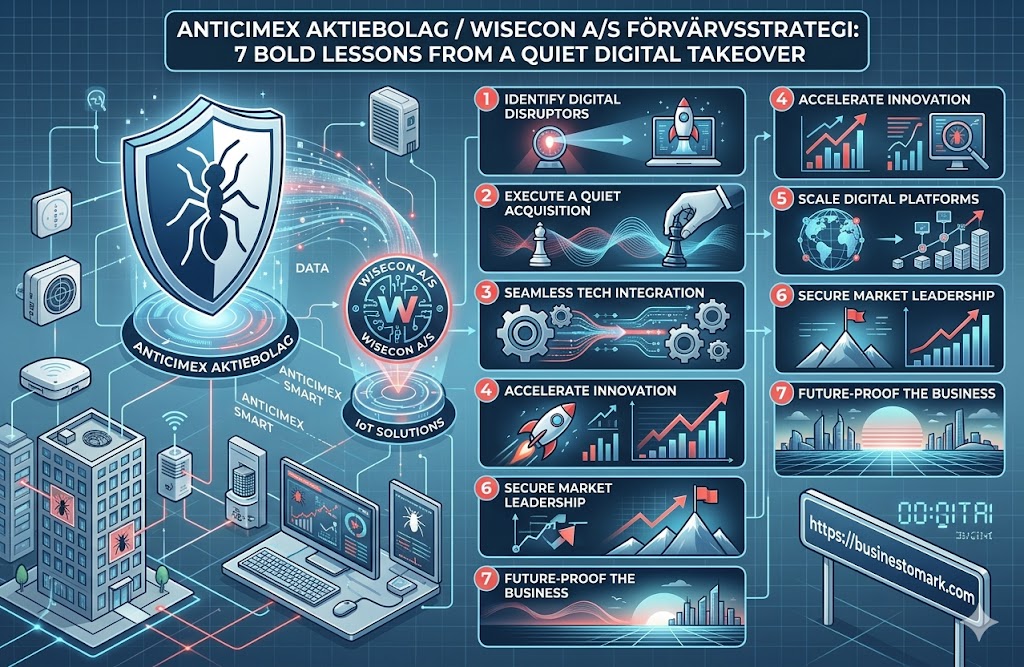
In 2015, Anticimex acquired 20% of WiseCon A/S, a Danish company known for digitally enabled pest control products. By 2017, Anticimex bought the remaining 80% and established what became the Anticimex Innovation Center in Helsinge, Denmark. That two-step move says a lot. Rather than swallowing a company whole on day one, Anticimex first tested, learned, scaled, and then fully integrated the capability. Smart, patient, and—let’s be honest—pretty elegant.
The Unusual Beauty of a “Boring” Industry
Pest control can look ordinary from the outside. A technician arrives, checks a site, solves a problem, files a report, and moves on. Simple, right? Well, not quite.
The hidden beauty is that pest control sits at the crossroads of health, safety, food protection, property care, and compliance. Restaurants, grocery stores, hospitals, warehouses, schools, apartment buildings, and factories can’t simply shrug and say, “We’ll deal with rats next quarter.” When pests appear, risk appears too.
That makes the industry unusually resilient. Customers need service again and again. The work is local, relationship-based, and often urgent. Plus, many smaller pest control businesses have strong neighborhood reputations but limited technology, capital, or international reach. That creates room for a larger company to grow through acquisitions while still keeping local trust alive.
Anticimex leaned into exactly that idea. Its M&A page says it looks for businesses with strong local knowledge that can use Anticimex’s strength to grow in their markets. It also describes a three-step acquisition process: origination, execution, and integration. In plain English, the company doesn’t just buy revenue. It buys relationships, know-how, routes, technicians, customer density, and—when the target is WiseCon—technology.
More Read

From Reactive Service to Preventive Thinking
Old-school pest control often worked like this: a customer noticed a problem, called for help, and a technician responded. That model works, but it has a built-in weakness. By the time a pest problem is visible, damage may already be underway.
Preventive pest control flips the script. Instead of waiting for trouble, the company monitors, detects, and acts early. That’s where digital tools matter. Sensors, connected traps, remote monitoring, and data dashboards let teams spot patterns before customers are staring at droppings in the storeroom. Not glamorous, sure, but incredibly useful.
Anticimex’s SMART concept uses intelligent traps and sensors to monitor and control pests, and the company says the WiseCon acquisition accelerated that concept. In business terms, this is more than a product upgrade. It’s a model upgrade.
Why WiseCon Was More Than a Purchase
WiseCon was not just another company in the portfolio. It was a capability purchase. That’s a big distinction.
Buying a local pest control firm can add customers, technicians, branch density, and local market share. Buying WiseCon added technology, intellectual property, product knowledge, digital thinking, and research capacity. In other words, Anticimex didn’t only expand sideways. It expanded upward.
When Anticimex announced the remaining 80% acquisition in 2017, it said the SMART concept was based on WiseCon’s technology and that more than 20,000 SMART rodent devices had already been installed worldwide. The company also said more than 20% of its new sales consisted of SMART digital traps at that time. Those numbers matter because they show the strategy had already moved beyond theory. The dog had learned the trick, so to speak.
More Read
The Digital Trap as a Business Signal
A digital trap may sound like a small product. But strategically, it sends a loud signal.
It says the future of pest control is not just killing pests. It’s gathering information. It’s documenting activity. It’s giving customers proof. It’s reducing unnecessary site visits. It’s improving route planning. It’s detecting risk before damage spreads. And yes, it’s creating a stickier service relationship.
Customers don’t only buy a trap. They buy peace of mind, compliance support, reporting, and faster action. For a food producer, that can be priceless. For a hotel, it can protect reputation. For a city or housing provider, it can reduce chaos.
Sensors, Data, and Smarter Routes
Dangling from the ceiling of this strategy, metaphorically speaking, is one beautiful idea: data makes service smarter.
A connected device can report activity without waiting for a human inspection. A technician can be sent where action is needed, not just where a calendar says they should go. A branch manager can see trends across sites. A customer can receive better documentation. Over time, the company can learn which environments create higher risk and which interventions work best.
Anticimex says its Innovation Center, formerly WiseCon, combines SMART Device Solutions and Group Digital Services, with teams working on products, analytics, and digital development. It also says SMART devices monitor pest infestations in real time and can support prevention, monitoring, and extermination without pesticides.
That’s not a tiny bolt-on. That’s a new nervous system.
How the Acquisition Strategy Worked
The genius of the Anticimex-WiseCon story is not merely that Anticimex bought a technology company. Plenty of companies buy technology and then accidentally bury it under process, politics, and PowerPoint decks. The interesting part is how Anticimex staged the move.
Step 1: Take a Stake
In 2015, Anticimex took a 20% stake in WiseCon. This was a toe in the water, not a cannonball dive. It allowed Anticimex to deepen the relationship, learn the technology, test market acceptance, and reduce uncertainty.
That’s a useful lesson for any company looking at innovation through acquisition. Sometimes, the smartest deal is not the biggest one. A minority stake can give both sides room to breathe. The buyer learns whether the technology fits. The seller learns whether the buyer is a true partner. Nobody has to pretend every answer is known on day one.
Step 2: Prove the Model
After the minority investment, Anticimex rolled out its SMART concept using WiseCon technology. By 2017, it had installed more than 20,000 SMART rodent devices worldwide. That rollout acted like a real-world exam.
Could the devices work at scale? Would customers buy them? Could technicians service them? Would the data actually help? Would the concept travel across markets?
Apparently, the answer was yes. And once the proof was strong enough, the next move became logical.
Step 3: Own the Capability
In 2017, Anticimex acquired the remaining 80% of WiseCon and established an Innovation Center for digital pest control. That last step changed WiseCon from a partner into a core engine of future development.
This is where Anticimex aktiebolag / wisecon a/s förvärvsstrategi becomes especially interesting. The acquisition was not just about control. It was about commitment. Full ownership meant Anticimex could align product development, intellectual property, manufacturing, data services, and global rollout around one shared direction.
Culture, Integration, and Local Strength
Here’s where many acquisition strategies trip over their own shoelaces: integration.
A buyer can have the money, the brand, and the consultants, but if it smothers the acquired company, value leaks out fast. People leave. Customers feel ignored. Local knowledge gets lost. The acquired business becomes a logo on a slide instead of a living organism.
Anticimex’s public M&A process stresses integration that keeps what works while acting on areas for improvement. It also describes onboarding employees into Anticimex culture, operational models, and SMART technology. That phrasing matters. “Keep what works” is the kind of sentence sellers like to hear, assuming the buyer means it.
Why Branches Still Matter
Digital tools are powerful, but pest control is still local. A sensor can detect activity, but a technician still understands the site. A dashboard can show a trend, but a branch team knows the customer’s building, habits, pressure points, and expectations.
Anticimex’s business model emphasizes a decentralized branch-based structure. The company says branches have the closest knowledge of local customers, competition, and market dynamics, and that this local knowledge affects service delivery and acquisitions.
That’s the balancing act: centralize technology, decentralize customer closeness. Or, to put it more casually, let the brain build the tools while the hands stay close to the work.
The Sustainability Angle
Modern pest control has a tough job. It must protect people, food, and property without causing unnecessary harm to the environment. That’s easier said than done.
Traditional pest control often relies heavily on chemicals, especially when problems are discovered late. Preventive digital systems can reduce that dependence by detecting issues earlier and targeting interventions more precisely.
Anticimex says SMART solutions enable prevention and early detection and can provide fast, often immediate and non-toxic remediation. The company also frames professional pest control as connected to public health, food protection, property protection, biodiversity, disease prevention, and reduced waste.
Less Poison, More Precision
There’s a neat phrase for this kind of shift: less poison, more precision.
When devices monitor activity around the clock, pest control becomes less about blanketing an area with treatment and more about placing the right action in the right spot at the right time. Customers gain better records. Technicians gain better direction. The environment gains a lighter touch.
EQT, Anticimex’s owner, has described SMART as a biocide-free digital pest control solution that uses connected sensors and non-toxic traps to detect and address pest activity in real time. EQT also reported that SMART contracts had higher contract size, stronger margins, lower cancellation rates, and reduced hazardous biocides by up to 100%.
That combination—commercial upside plus sustainability upside—is exactly why the WiseCon acquisition deserves attention. It wasn’t charity. It wasn’t green window dressing. It was business value wearing practical shoes.
Strategic Lessons for Modern Companies
So, what can other businesses learn from this deal? Quite a bit, actually.
- Don’t buy innovation just to look innovative.
Buy it because it strengthens the customer offer, improves operations, and supports the long-term strategy. - Start small when uncertainty is high.
Anticimex first bought a minority stake, then moved to full ownership after the model had more proof. - Use acquisitions to build capabilities, not just size.
WiseCon added technology and R&D depth, not merely revenue. - Keep local strength alive.
In route-based service businesses, local knowledge is gold. Lose it, and the deal can turn sour quickly. - Make integration practical.
Culture matters, but so do systems, tools, reporting, training, and clear roles. - Connect sustainability to customer value.
Greener solutions work best when they also help customers reduce risk, improve documentation, and solve problems faster. - Turn data into a service advantage.
Devices are useful. Data is powerful. But service built on data? That’s where the magic starts.
A Human View of the Deal
Picture a warehouse manager named Lena. She’s got food products stacked high, auditors visiting next week, and no patience for surprises. In the old model, she might wait for a technician’s scheduled visit or call after spotting signs of rodents. Stressful? You bet.
Now imagine connected devices quietly monitoring activity. When something changes, the system flags it. A technician arrives with purpose, not guesswork. Lena gets documentation. The risk is handled early. Nobody throws confetti, but her day just got much better.
That’s the human side of this acquisition strategy. It’s not about gadgets for gadgets’ sake. It’s about making invisible problems visible sooner.
And that’s why the story sticks.
FAQs
What was the main idea behind the Anticimex and WiseCon deal?
The main idea was to strengthen Anticimex’s digital pest control capabilities. WiseCon brought advanced electronic traps, monitoring systems, and product knowledge that helped Anticimex expand its SMART preventive pest control services.
Why did Anticimex first buy only 20% of WiseCon?
A minority stake gave Anticimex time to test the partnership, prove the technology, and understand how WiseCon’s products could scale across markets. It was a careful, low-risk way to build confidence before full ownership.
When did Anticimex fully acquire WiseCon?
Anticimex acquired the remaining 80% of WiseCon in 2017 after first buying a 20% stake in 2015. The full acquisition also led to the establishment of the Anticimex Innovation Center in Denmark.
What is Anticimex SMART?
Anticimex SMART is a digital pest control concept that uses intelligent traps, sensors, monitoring, and data to detect and manage pest activity. The goal is to move pest control from reactive treatment to preventive action.
Why is the WiseCon acquisition important for sustainability?
The acquisition helped Anticimex scale digital tools that can detect pest activity early and reduce unnecessary pesticide use. This supports more precise, preventive, and environmentally conscious pest control.
What can other companies learn from this acquisition strategy?
Other companies can learn to acquire capabilities, not just customers. The deal shows the value of testing partnerships, proving technology, integrating carefully, and linking innovation to real customer needs.
Is pest control really a technology-driven industry now?
Increasingly, yes. While technicians and local service remain essential, connected devices, data, remote monitoring, and predictive insights are changing how pest control companies prevent and solve problems.
Conclusion
The story of Anticimex aktiebolag / wisecon a/s förvärvsstrategi is not loud, flashy, or wrapped in Silicon Valley glitter. That’s exactly why it’s worth studying.
It shows how a practical service company can become more digital without losing its local roots. It shows how acquisitions can build capability instead of just adding size. It shows how sustainability can support stronger customer value. And most of all, it shows the power of patient strategy.
Anticimex didn’t simply buy WiseCon and hope for the best. It invested, learned, scaled, integrated, and turned a Danish technology specialist into a central part of its global innovation engine. Quietly, steadily, and with a clear eye on prevention, the company helped reshape what modern pest control could become.
Not bad for an industry people often overlook, right?