



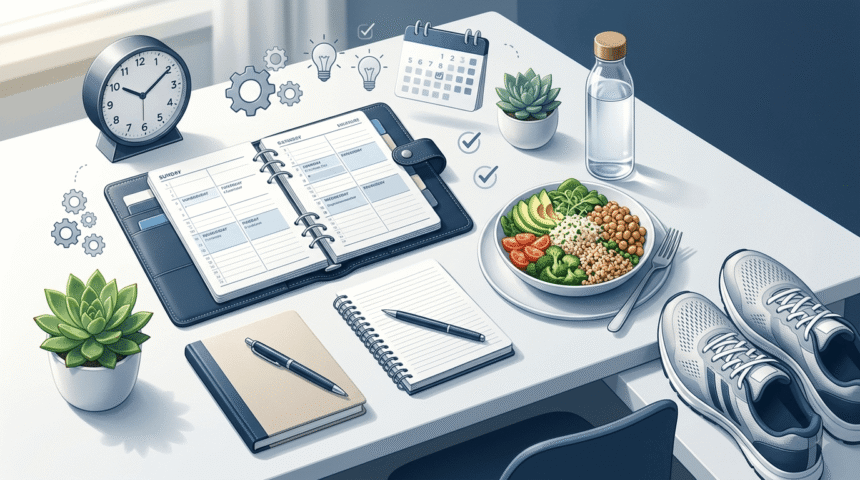
Practical Habits for a More Productive and Balanced Life are not about filling every hour with work. They are about creating simple routines that help important tasks get done without allowing work, screens, or daily responsibilities to consume all available time.
Productivity and balance work best together. A person may complete a long task list but still feel exhausted, distracted, or disconnected from family and personal interests. A better approach is to build habits around priorities, focused work, adequate rest, physical activity, healthy routines, and realistic boundaries.
This guide explains practical habits that can be introduced gradually, why they work, where common productivity advice fails, and how to create a routine that remains useful when life becomes unpredictable.
What Does a Productive and Balanced Life Actually Mean?
A productive life is not necessarily one in which the maximum number of tasks are completed. Productivity is better understood as making meaningful progress on important responsibilities while using time and energy deliberately.
Balance adds another dimension. It means that work or study is given appropriate attention without completely crowding out sleep, health, relationships, recreation, and personal recovery.

A balanced routine may therefore include:
- Focused periods for important work
- Time for exercise and movement
- Consistent sleep
- Nutritious meals
- Social and family connections
- Breaks and leisure
- Time for planning and reflection
- Boundaries around unnecessary commitments
The exact arrangement will differ from person to person. A student, parent, entrepreneur, employee, and retired person will have different schedules and responsibilities.
The goal is not to copy someone else’s routine. It is to create a structure that supports your own priorities.
Practical Habits for a More Productive and Balanced Life Start With Priorities
One of the most useful changes is to stop treating every task as equally important.
A long task list can create the impression of productivity while leaving the most valuable work unfinished. Prioritization helps separate activities that genuinely matter from activities that simply happen to be available.
Choose Three Important Tasks
At the beginning of the day, identify three meaningful tasks.
They should represent outcomes rather than vague intentions.
For example:
- Instead of “work on website,” choose “publish the completed article.”
- Instead of “study,” choose “complete two chapters and review the notes.”
- Instead of “business work,” choose “finish the product comparison.”
Other tasks can still be completed, but these three provide a clear definition of progress.
Separate Urgent From Important
Urgent tasks demand attention quickly, but they are not always the tasks that create the greatest long-term value.
An email may be urgent because someone is waiting for a response. Learning a professional skill may be more important because it affects future opportunities.
A useful weekly review can therefore ask:
- What needs immediate attention?
- What produces meaningful long-term progress?
- What can be delegated?
- What can be delayed?
- What can simply be removed?
This process prevents the schedule from being controlled entirely by incoming requests.
Build a Simple Daily Planning System
Planning does not need to consume an hour every morning. A short planning routine can provide enough structure for the day.
A practical system is to divide the day into three categories:
| Category | Purpose | Example |
|---|---|---|
| Deep work | Important concentration-heavy work | Writing, studying, analysis |
| Maintenance | Necessary routine tasks | Email, administration, errands |
| Recovery | Activities that restore energy | Walking, meals, hobbies, family time |
This approach is more flexible than scheduling every minute.
Use Time Blocks Instead of an Endless To-Do List
Time blocking means assigning a period to a particular type of work.
For example:
9:00–11:00: focused project
11:00–11:30: break
11:30–12:30: communication and administration
2:00–3:30: second focused session
5:00 onward: personal time
The exact times do not matter as much as the principle. Important work receives protected attention instead of being squeezed between notifications.
Protect Your Attention From Constant Switching
Modern productivity problems are often attention problems rather than time problems.
Checking email while writing, responding to messages during study, and switching between multiple browser tabs can create a sense of activity without providing sustained concentration.
Research summarized by the American Psychological Association shows that switching between tasks can create efficiency costs, particularly when the tasks are complex.
Try Single-Tasking for Difficult Work
When a task requires concentration:
- Put the phone away or silence notifications.
- Close unrelated browser tabs.
- Keep only necessary applications open.
- Work on one clearly defined outcome.
- Check messages during a designated period.
Single-tasking does not mean refusing to multitask in every situation. Simple activities can sometimes be combined. The bigger concern is repeatedly switching attention during demanding work.
Create a Distraction List
An unexpected idea can interrupt focused work.
Instead of immediately acting on it, write it down.
For example:
“Check new software later.”
Then return to the current task.
This simple technique prevents small thoughts from turning into repeated interruptions.
Make Sleep a Productivity Habit
Sleep is sometimes treated as time that could be used for additional work. That approach can backfire.
The CDC’s 2026 data from the U.S. National Health Interview Survey found that 30.5% of adults reported getting less than seven hours of sleep on average in 2024.
Sleep needs vary by individual, but adults generally need adequate sleep to support normal physical and cognitive functioning.
Create a Consistent Sleep Routine
A practical evening routine can include:
- Going to bed at a reasonably consistent time.
- Reducing stimulating activities before bed.
- Keeping the bedroom comfortable and suitable for sleep.
- Avoiding unnecessary late-night work.
- Preparing the next day’s essentials before going to bed.
The purpose is not perfection. A consistent routine makes it easier to protect sleep when the schedule becomes busy.
If persistent sleep problems are affecting daily functioning, general productivity advice should not replace professional medical guidance.
Move Throughout the Day
Exercise should not be viewed only as a separate gym session.
Walking, cycling, household activities, recreational sports, and structured workouts can all contribute to physical activity.
The World Health Organization recommends that adults get at least 150–300 minutes of moderate-intensity aerobic activity per week, or an equivalent amount of vigorous activity. Muscle-strengthening activities are also recommended on at least two days per week.
Make Movement Easier to Start
A common mistake is creating an exercise plan that is too demanding to maintain.
Instead, connect movement to existing routines:
- Walk during a suitable break.
- Take stairs when practical.
- Stretch after long periods of sitting.
- Walk while listening to an audio program.
- Schedule exercise like an appointment.
- Use short movement sessions when a full workout is unrealistic.
The key is consistency rather than designing the most impressive routine.
Eat in a Way That Supports Energy
Food affects more than physical health. Eating patterns can also influence how comfortable and energetic a person feels during the day.
A balanced diet generally involves variety and appropriate proportions rather than eliminating one category of food without a specific reason.
The NHS recommends a varied diet containing fruit and vegetables, higher-fibre starchy foods, protein sources, dairy or alternatives, and small amounts of unsaturated oils and spreads.
Make Healthy Choices Convenient
Environment often matters more than motivation.
If nutritious food requires extensive preparation while less nutritious options are immediately available, the easier option may win during a busy day.
Useful habits include:
- Keeping simple nutritious foods available.
- Planning several meals ahead.
- Preparing ingredients in advance.
- Drinking enough fluids.
- Avoiding excessive reliance on highly processed convenience foods.
There is no need for every meal to be perfect. The overall pattern matters more than one meal.
Use Technology Deliberately
Technology can improve productivity, but it can also fragment attention.
Notifications are particularly problematic because they turn other people’s priorities into interruptions inside your own schedule.
A better approach is to decide when technology deserves access to your attention.
Create Notification Rules
Consider disabling nonessential notifications from:
- Social media
- Shopping applications
- Games
- Promotional emails
- News alerts
- Nonurgent messaging groups
Keep genuinely important notifications available.
You can also create specific periods for checking email and messages instead of responding immediately to every alert.
Set Boundaries Around Work
A balanced life becomes difficult when work has no clear stopping point.
This problem is especially common for remote workers, freelancers, entrepreneurs, and people who use the same devices for both work and personal activities.
Create a Shutdown Routine
At the end of the workday:
- Review unfinished tasks.
- Record the next action for important projects.
- Check whether anything genuinely requires immediate attention.
- Close work applications.
- Physically leave the workspace when possible.
The unfinished work does not need to disappear. It simply needs to be captured somewhere reliable.
This reduces the temptation to keep mentally solving work problems throughout the evening.
Schedule Recovery Instead of Waiting for It
One of the most overlooked practical habits is treating recovery as part of the schedule rather than something that happens only after everything else is finished.
Everything rarely gets finished.
A person who waits for a completely empty schedule before resting may continue waiting indefinitely.
Recovery can include:
- Quiet time
- Walking
- Reading
- Hobbies
- Family activities
- Social interaction
- Time outdoors
- Relaxation without productivity goals
The activity does not need to produce measurable output.
Protect Relationships From the Productivity Trap
A highly optimized schedule can still produce an unbalanced life if relationships are continually postponed.
Social connection is not merely an optional reward for finishing work. For many people, relationships are an important part of a satisfying life.
Small habits can help:
- Have meals without unnecessary devices.
- Schedule regular calls with distant family.
- Give conversations your full attention.
- Protect time for important relationships.
- Avoid checking work messages during meaningful personal moments.
The goal is not to eliminate technology or work from personal life. It is to prevent them from occupying every available space.
Learn to Say No to Low-Value Commitments
A calendar becomes crowded not only because of the work you choose but also because of the work you accept.
Before agreeing to another responsibility, ask:
Does this support an important goal, responsibility, relationship, or value?
If not, consider declining, delaying, simplifying, or delegating it.
A polite “no” can protect hours of future time.
This is particularly valuable for people who regularly accept small requests that appear harmless individually but become overwhelming when combined.
Use a Weekly Reset
Daily planning handles immediate priorities. A weekly reset provides a broader view.
Set aside a short period once a week to review:
Work
- What was completed?
- What remains unfinished?
- Which project needs attention next?
Personal Life
- Was enough time spent with family or friends?
- Was there time for recreation?
- Were personal commitments neglected?
Health
- Was adequate sleep obtained?
- Was movement consistent?
- Were meals reasonably balanced?
Mental Load
- What is creating unnecessary stress?
- What can be removed?
- What needs to be discussed or resolved?
The purpose is not to criticize yourself. It is to adjust the system.
Practical Habits Work Better When They Are Small
One reason productivity systems fail is that too many changes are introduced simultaneously.
Someone may decide to wake up early, exercise every morning, meditate, read 50 pages, eliminate social media, plan every hour, cook every meal, and complete several hours of deep work.
That system may look impressive for a few days.
It may also be difficult to sustain.
Start With One Anchor Habit
An anchor habit is a behavior attached to an existing part of the day.
Examples:
- After breakfast → review the day’s top three priorities.
- After lunch → take a short walk.
- Before closing the laptop → write tomorrow’s first task.
- After brushing your teeth → prepare for sleep.
Existing routines provide a stable starting point.
The Habits That Matter Most Are Not Always the Most Visible
1. Leave Space Between Commitments
A schedule with no buffer is fragile.
If one meeting takes longer than expected, the entire day can become delayed.
Leaving small gaps between commitments provides room for unexpected events.
2. Define a Minimum Version of Important Habits
On a difficult day, the goal should not always be to maintain the full routine.
Instead, create a minimum version.
For example:
- Full workout → 10-minute walk
- One hour of reading → 10 pages
- Two hours of deep work → 20 focused minutes
- Full meal preparation → simple nutritious meal
This prevents an imperfect day from becoming a complete abandonment of the habit.
3. Track Outcomes, Not Just Streaks
Streaks can encourage consistency, but they can also become a source of unnecessary pressure.
Instead of asking only, “Did I complete my habit today?” ask:
- Did this habit improve my day?
- Did it help me make progress?
- Was the routine realistic?
- Should the habit be changed?
A system should serve the person using it.
Common Productivity Advice That Does Not Always Work
Not every popular productivity technique is universally useful.
| Common Advice | Potential Problem | Better Approach |
|---|---|---|
| Wake up extremely early | May reduce sleep | Wake early enough to protect sleep |
| Schedule every minute | Leaves little flexibility | Use broad time blocks |
| Multitask constantly | Can increase switching costs | Single-task demanding work |
| Work longer hours | Can reduce recovery | Protect meaningful work and rest |
| Follow a strict morning routine | May not fit every schedule | Build a flexible starting ritual |
| Track every habit | Can become another burden | Track only useful behaviors |
| Eliminate all leisure | Can create an unsustainable routine | Schedule genuine recovery |
The best system is not necessarily the most disciplined-looking one. It is the one that can continue during ordinary weeks, stressful periods, travel, illness, family obligations, and unexpected changes.
A Simple Daily Framework for Balance
A flexible day could look like this:
Morning
- Wake at a consistent time when practical.
- Eat and hydrate.
- Review the day’s priorities.
- Begin with the most important task when possible.
Middle of the day
- Continue focused work.
- Take appropriate breaks.
- Eat a balanced meal.
- Add movement instead of remaining seated continuously.
Afternoon
- Complete administrative tasks.
- Finish the day’s key responsibilities.
- Review what remains unfinished.
Evening
- Transition away from work.
- Spend time with people or activities that matter.
- Prepare for tomorrow.
- Begin a calming pre-sleep routine.
This is a framework, not a rulebook. Shift workers, parents, students, and people with irregular schedules may need very different structures.
How to Build Practical Habits That Last
A sustainable habit usually needs three things: a clear behavior, a realistic trigger, and an environment that makes the behavior easier.
For example:
Goal: Read more
Behavior: Read 10 pages
Trigger: After dinner
Environment: Keep the book beside the usual chair
Another example:
Goal: Reduce distractions
Behavior: Silence nonessential notifications
Trigger: Beginning focused work
Environment: Keep the phone outside the workspace
This approach is more actionable than simply deciding to “be more productive.”
Frequently Asked Questions
What are the most important habits for a balanced life?
The most useful foundation includes adequate sleep, regular physical activity, nutritious eating, focused work, meaningful relationships, personal downtime, and realistic planning. The ideal combination varies from person to person, but people can create a more balanced routine by ensuring that work does not consistently displace health, recovery, and important relationships.
How can I become more productive without working longer?
Start by reducing unnecessary switching and prioritizing high-value work. Choose a few important outcomes each day, protect focused work periods, limit unnecessary notifications, and review unfinished tasks rather than repeatedly carrying them in your head. People can often improve productivity by focusing their attention and prioritizing tasks instead of working longer hours.
How many habits should I start at once?
Starting with one to three habits is usually more manageable than changing an entire routine at once. Choose behaviors that are small, specific, and connected to existing routines. Once those habits become reasonably stable, you can introduce additional habits if they genuinely improve your life.
Can technology help create a more balanced routine?
Yes. Calendars, reminders, task managers, screen-time controls, and habit trackers can reduce mental load and organize responsibilities. However, technology should support attention rather than constantly interrupt it. People should limit nonessential notifications and regularly review their digital tools to make sure they remain useful.
Is waking up early necessary for productivity?
No. Productivity does not require a universally fixed wake-up time. Sleep duration, schedule demands, health, work patterns, and individual preferences all matter. A person working late shifts, for example, may have a completely different productive schedule from someone working traditional daytime hours.
How can I stay productive when I feel overwhelmed?
Reduce the number of active priorities. Write down everything competing for attention, identify what genuinely needs action, and choose one next step. Taking a short walk, eating a meal, having a conversation, or resting for a while may also help when exhaustion makes you feel overwhelmed.
How much exercise should adults get?
WHO recommends adults get at least 150–300 minutes of moderate-intensity aerobic activity per week, or 75–150 minutes of vigorous activity, with muscle-strengthening activities on at least two days each week. Individual circumstances can affect what is appropriate, so people with specific health concerns should seek personalized professional advice.
A Better Way to Think About Productivity and Balance
The strongest routines are rarely built around constant optimization.
They are built around repeatable decisions.
When people clearly identify important work, control distractions, protect their sleep, stay active, eat balanced meals, and give genuine attention to personal relationships, they rely less on willpower to stay productive.
The same principle applies when life becomes difficult. A sustainable routine should be flexible enough to shrink when necessary and expand when circumstances improve.
Practical Habits for a More Productive and Balanced Life are therefore less about doing everything perfectly and more about creating a dependable structure around what matters most. Start small, protect your energy, review your routine regularly, and remove habits that create more complexity than value.
Conclusion
A productive lifestyle does not require every hour to be optimized. Practical Habits for a More Productive and Balanced Life are built around manageable routines that protect time, attention, health, relationships, and recovery. Start with a few realistic habits, adjust them to your circumstances, and focus on consistency rather than perfection. The most effective routine is one that supports meaningful progress while still leaving enough space to live well.