



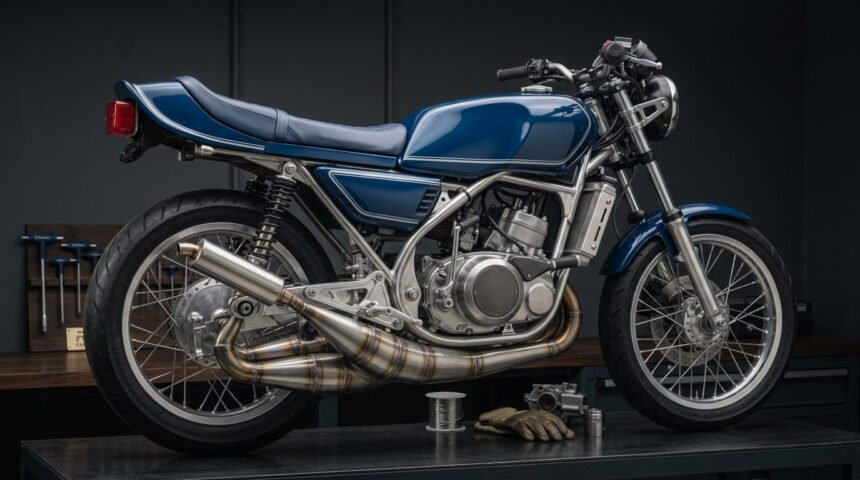
Escapamento RD: Performance, Customization & Benefits is a topic closely associated with Yamaha RD motorcycles, particularly the RD 125, RD 135 and RD 350. For these two-stroke motorcycles, the exhaust is more than a tube that carries combustion gases away from the engine. Its dimensions and internal design can influence how the engine delivers power, where the powerband occurs, the motorcycle’s sound, and how the bike responds to modifications.
That is why choosing an RD exhaust requires more than selecting the loudest or largest-looking pipe. A suitable system needs to match the motorcycle, engine configuration and intended use. Compatibility also matters because exhaust systems advertised for RD models can differ in dimensions, mounting arrangements and specifications. Current Brazilian listings, for example, show separate configurations for RD 125/135 applications.
This guide explains how an RD exhaust works, its potential performance benefits, customization options, tuning considerations, limitations and the legal points riders should understand before modifying a motorcycle.
What Is an Escapamento RD?
“Escapamento” is Portuguese for exhaust system. In the context of motorcycle enthusiasts, Escapamento RD generally refers to exhaust systems designed for or fitted to Yamaha RD motorcycles.
The term is particularly relevant because Yamaha’s RD family includes two-stroke motorcycles whose exhaust design plays an unusually important role in engine operation. Unlike a basic four-stroke exhaust, a two-stroke expansion chamber can use pressure waves to influence the movement of exhaust gases and fresh charge around the exhaust port.
This makes the exhaust part of the engine’s overall tuning strategy rather than simply an outlet for gases.
Available Brazilian parts listings illustrate how broad the market is. RD-related exhausts are available in original-style, replacement and competition-oriented configurations, with examples for RD 125/135 and other RD applications.
Which Yamaha RD Models Use These Exhaust Systems?
Common applications include:
- Yamaha RD 125
- Yamaha RD 135
- Yamaha RDZ 135
- Yamaha RD 350
- Other RD-based or modified applications, depending on the specific exhaust design
These motorcycles should not automatically be treated as interchangeable. An exhaust that fits one RD model may require different dimensions, brackets or tuning for another.
How an RD Exhaust Works on a Two-Stroke Engine
The most important technical difference is the expansion chamber.
A two-stroke engine completes its cycle differently from a four-stroke engine. During the exhaust phase, burned gases leave the cylinder through the exhaust port. When the exhaust system is properly designed, pressure waves travel through the chamber and return toward the cylinder.
The timing of these waves can influence how effectively the engine clears exhaust gases and how much of the fresh mixture remains in the cylinder before the exhaust port closes.
This is why expansion-chamber dimensions matter.
A change in:
- Header length
- Chamber diameter
- Cone angles
- Belly diameter
- Stinger dimensions
- Silencer design
can shift the engine’s power characteristics.
The result is not simply “more power.” A particular exhaust can move the strongest part of the powerband toward higher or lower engine speeds.
Escapamento RD: Performance Benefits
A properly matched exhaust can provide several performance advantages, but the exact result depends on the motorcycle and engine setup.
1. Different Power Delivery
One of the biggest effects of a tuned two-stroke exhaust is changing where the engine produces its strongest power.
A high-RPM-oriented chamber may produce stronger performance toward the upper part of the rev range. Another design may provide a broader or more street-friendly powerband.
This means a rider should choose the exhaust based on intended use rather than assuming that every performance chamber produces the same result.
2. Stronger Throttle Response
A suitable exhaust can change how quickly the engine responds to throttle input.
However, throttle response depends on more than the exhaust. Carburetor setup, ignition timing, engine condition, air filtration and compression all contribute.
An exhaust installed on an otherwise poorly tuned engine may not deliver the expected improvement.
3. Changes in Peak Power
Expansion-chamber design can affect the engine’s ability to produce power at particular engine speeds.
That does not mean every aftermarket exhaust automatically increases peak horsepower. In some cases, an exhaust can increase power in one part of the rev range while reducing it elsewhere.
A dyno test is the most reliable way to determine the actual result on a particular engine.
4. Potential Weight Reduction
Some aftermarket exhaust systems use different materials or construction methods from original equipment.
A lighter exhaust can reduce overall motorcycle weight, although the amount varies considerably between products.
The material alone should not be used as a guarantee of performance. Construction quality, chamber design and fitment are equally important.
5. Distinctive Exhaust Sound
The exhaust system has a major influence on the characteristic sound of a two-stroke motorcycle.
An RD with a performance-oriented exhaust may sound sharper and more pronounced than one using a quieter original-style system.
Sound, however, should not be confused with power. A louder exhaust is not automatically a better-performing exhaust.
Original vs Performance Escapamento RD
Choosing between an original-style exhaust and a performance system depends largely on the purpose of the motorcycle.
| Feature | Original-Style Exhaust | Performance Exhaust |
|---|---|---|
| Main purpose | Restoration and everyday use | Performance tuning |
| Powerband | Generally suited to stock configuration | Can be shifted or reshaped |
| Sound | Usually more controlled | Often louder or more pronounced |
| Engine tuning | Usually simpler | May require additional tuning |
| Appearance | Period-correct | Sportier/custom |
| Restoration value | Often preferred | Depends on the project |
| Daily usability | Generally predictable | Depends on design |
| Legal considerations | Usually simpler | Certification and noise requirements need checking |
An original-style system can make more sense for a restoration where maintaining the motorcycle’s period appearance and factory character is important.
A performance chamber may be more appropriate for a modified engine or a rider specifically looking to change the powerband.
Customization Options for an Escapamento RD
Customization is one reason RD exhaust systems remain popular among motorcycle enthusiasts.
Chrome and Polished Finishes
Chrome and polished metal finishes are commonly seen on RD-related replacement exhausts. Current Brazilian listings include chrome RD 125/135 systems, including configurations positioned above or below the footpeg.
These finishes can complement a classic restoration, particularly when other motorcycle components have been restored to a period-correct appearance.
The drawback is that appearance-focused finishes still require maintenance. Heat, moisture, road debris and corrosion can affect the finish over time.
Black Finishes
Black exhausts provide a more understated appearance and are common on performance-oriented motorcycles.
A high-temperature coating can also be selected for specific applications, but the coating must be appropriate for exhaust temperatures.
High- and Low-Mounted Designs
RD exhausts can be positioned differently depending on the model and intended configuration.
Some RD 125/135 products are marketed as:
- Média alta
- Média baixa
- Por cima do estribo
- Por baixo do estribo
These differences are not purely cosmetic. Position affects clearance, mounting and the relationship between the exhaust and other motorcycle components.
Why Exhaust Tuning Matters on an RD
A common misconception is that installing a larger or more open exhaust automatically improves an engine.
Two-stroke engines are particularly sensitive to exhaust characteristics. Changing the exhaust can alter the engine’s airflow and fuel requirements.
For example, a Brazilian product listing for an RD-related exhaust specifically warns that carburetor adjustment may be necessary after installation.
That is an important practical detail because an exhaust modification should be considered as part of a complete setup.
Carburetor Adjustment
After an exhaust change, the carburetor may require adjustment to suit the new engine characteristics.
Depending on the motorcycle and modification, this can involve:
- Main jet selection
- Needle position
- Pilot circuit adjustment
- Air/fuel mixture
- Idle adjustment
The correct settings cannot safely be determined from the exhaust name alone. Engine condition, fuel, intake configuration, elevation and other modifications also matter.
A qualified motorcycle technician should verify the setup.
Common Mistakes When Choosing an Escapamento RD
Buying Based Only on Pipe Size
A larger diameter does not automatically mean better performance.
Exhaust performance depends on the complete geometry of the system, not one measurement.
Choosing Sound Over Function
A loud exhaust can make a motorcycle seem more powerful, but sound is not a reliable indicator of horsepower.
Ignoring Model Compatibility
An RD 125/135 exhaust should not be assumed to fit every Yamaha RD.
Check:
- Motorcycle model
- Model year where relevant
- Mounting points
- Exhaust-port connection
- Footpeg clearance
- Frame clearance
- Silencer position
Current Brazilian listings themselves distinguish between different RD applications, which reinforces the need to verify fitment before purchase.
Installing Without Checking Fueling
A major exhaust change can require carburetor tuning. Ignoring that step can produce poor running and potentially create an unsuitable mixture.
Removing the Silencer
Removing or disabling the silencer to make the motorcycle louder is not the same as performance tuning.
Brazilian traffic guidance identifies the silencer as part of the motorcycle’s noise-control equipment, and a defective, inoperative or improperly altered system can create a compliance problem.
Legal Considerations for RD Exhaust Modifications in Brazil
This is an area riders should take seriously.
Brazilian rules regulate vehicle equipment, noise and emissions. IBAMA explains that the LCM system addresses emissions from motorcycles and similar vehicles, including pollutants and noise.
The Brazilian traffic authorities also distinguish between a legitimate replacement exhaust and an altered or non-compliant exhaust.
A Polícia Militar de Sergipe explanation of the applicable rules states that replacing part or all of a motorcycle exhaust can be permitted when the replacement maintains the required pollution and noise-control devices and has the applicable Inmetro certification.
The details can depend on the motorcycle, component and applicable certification requirements.
Why Certification Matters
The Brazilian traffic guidance specifically addresses non-original exhausts and certification requirements. The official enforcement material notes that certain replacement components are subject to Inmetro certification rules, depending on their application and vehicle category.
For that reason, buyers should not assume that an aftermarket exhaust is legal simply because it is sold online.
Local Rules Can Also Matter
National requirements are not necessarily the only consideration.
Local authorities can impose additional rules concerning excessive motorcycle noise. For example, a 2025 municipal law in Miguel Pereira, Rio de Janeiro, addressed the installation, sale and use of motorcycle exhausts that are not original or that increase noise beyond applicable limits.
The practical lesson is simple: check federal requirements and any rules that apply in the area where the motorcycle will be operated.
Materials Used in RD Exhaust Systems
Different materials offer different combinations of weight, durability, appearance and cost.
| Material | Main Advantage | Main Consideration |
|---|---|---|
| Carbon steel | Traditional construction and generally accessible cost | More vulnerable to corrosion |
| Stainless steel | Better corrosion resistance | Can cost more |
| Chrome-plated steel | Classic appearance | Finish requires care |
| Aluminum components | Low weight in suitable applications | Not appropriate for every hot exhaust section |
| Specialized alloys | Potential weight and heat advantages | Higher cost and application-specific |
A current Brazilian RD exhaust listing, for example, identifies carbon steel/iron as the material for a replacement system.
The best material depends on whether the priority is restoration, daily riding, appearance, racing use or long-term corrosion resistance.
Maintenance Tips for an RD Exhaust
Even a well-made exhaust needs regular inspection.
Check for Rust
Look for corrosion around:
- Welds
- Mounting brackets
- Joints
- Lower sections of the chamber
- Silencer connections
Rust can eventually create holes that change sound and exhaust performance.
Inspect Mounting Points
Vibration is a normal part of motorcycle operation, and loose or stressed mounting points can eventually cause cracks.
Check fasteners and brackets periodically, particularly after installing a new system.
Look for Exhaust Leaks
A leaking connection can produce unusual noise and may affect how the exhaust system functions.
Black carbon marks around a joint can be a useful visual warning that gases are escaping where they should not.
Maintain the Silencer
The silencer is not simply an accessory for reducing sound. Its condition can affect noise, exhaust behavior and legal compliance.
Original Exhaust or Custom Exhaust: Which Is Better?
There is no universal answer.
An original-style exhaust is usually the more logical choice when the motorcycle is being restored, preserved or used primarily for normal road riding.
A performance exhaust makes more sense when the motorcycle has a broader engine-tuning strategy and the owner understands that exhaust, fueling and engine characteristics need to work together.
The right question is therefore not “Which exhaust is the most powerful?”
A better question is:
Which exhaust best matches this RD’s engine, riding purpose and legal requirements?
Frequently Overlooked Details About Escapamento RD
One of the most useful distinctions is between peak power and usable power.
An exhaust that produces stronger performance at very high RPM may not feel better in everyday traffic if the rider spends most of the time below that range.
A second overlooked issue is the relationship between exhaust geometry and engine modifications. An exhaust developed for a relatively stock engine may behave differently when paired with changes to the carburetor, intake, cylinder, ignition or porting.
Another consideration is restoration value. For a collectible RD, replacing an original exhaust with an aggressive aftermarket system may improve performance but reduce the motorcycle’s period-correct character.
Finally, availability should not be confused with compatibility. Online marketplaces currently contain hundreds of RD-related exhaust listings and multiple brands and configurations, but that variety makes checking exact fitment even more important.
Who Should Consider an RD Performance Exhaust?
An aftermarket system may make sense for:
- Riders building a performance-oriented RD
- Owners tuning a two-stroke engine as a complete system
- Enthusiasts seeking a particular powerband
- Custom motorcycle builders
- Riders restoring an RD with a specific visual theme
An original or original-style system may be better for:
- Period-correct restorations
- Mostly stock motorcycles
- Daily riders prioritizing predictable behavior
- Owners concerned about noise and compliance
- Collectors preserving factory character
Frequently Asked Questions
What is an Escapamento RD?
An Escapamento RD is an exhaust system associated with Yamaha RD motorcycles, particularly two-stroke models such as the RD 125, RD 135 and RD 350. Depending on the design, it may be an original-style replacement or a performance-oriented expansion chamber intended to change exhaust behavior and the engine’s power delivery.
Does an Escapamento RD increase horsepower?
It can change power output, but an increase is not guaranteed. Exhaust geometry affects where and how an RD engine produces power. A performance chamber may strengthen one part of the RPM range while sacrificing another. Carburetor settings and other engine modifications also influence the final result.
Does an RD exhaust require carburetor tuning?
It can. A significant exhaust change may alter the engine’s operating characteristics and require carburetor adjustment. Some Brazilian RD exhaust listings explicitly warn that carburetor adjustment may be necessary.
Are RD 125 and RD 135 exhausts interchangeable?
Not automatically. Some products are specifically marketed for both RD 125 and RD 135, but exact compatibility depends on the exhaust design and motorcycle configuration. Buyers should verify mounting points, dimensions, exhaust-port fitment and clearance before purchasing.
Is a louder RD exhaust more powerful?
No. Loudness and performance are different characteristics. A louder exhaust may simply have less sound attenuation. Engine performance depends on exhaust geometry, pressure-wave behavior, fueling and the rest of the engine setup.
Is an aftermarket motorcycle exhaust legal in Brazil?
It can be legal when it meets the applicable requirements, including relevant noise, emissions and certification rules. Brazilian authorities specifically address replacement exhausts, certification and noise-control equipment. Requirements can vary by component and vehicle, so owners should verify the current rules before installation.
What is the best material for an RD exhaust?
There is no single best material. Carbon steel can suit traditional or cost-conscious applications, while stainless steel offers stronger corrosion resistance. Chrome finishes can work well for classic styling. The exhaust’s design, construction quality and compatibility are generally more important than material alone.
Conclusion
Escapamento RD: Performance, Customization & Benefits is ultimately about choosing an exhaust that matches the motorcycle rather than simply choosing the loudest or largest system available.
For Yamaha RD two-strokes, exhaust geometry can influence power delivery, throttle response and the location of the powerband. Custom finishes and mounting configurations also allow owners to change the motorcycle’s appearance. At the same time, major exhaust changes may require carburetor tuning and careful inspection of fitment.
For road use in Brazil, legality should be part of the decision from the beginning. Noise-control equipment, certification and applicable vehicle regulations all matter.
The best RD exhaust is therefore the one that balances performance, sound, appearance, compatibility, engine tuning, durability and compliance for the specific motorcycle.