

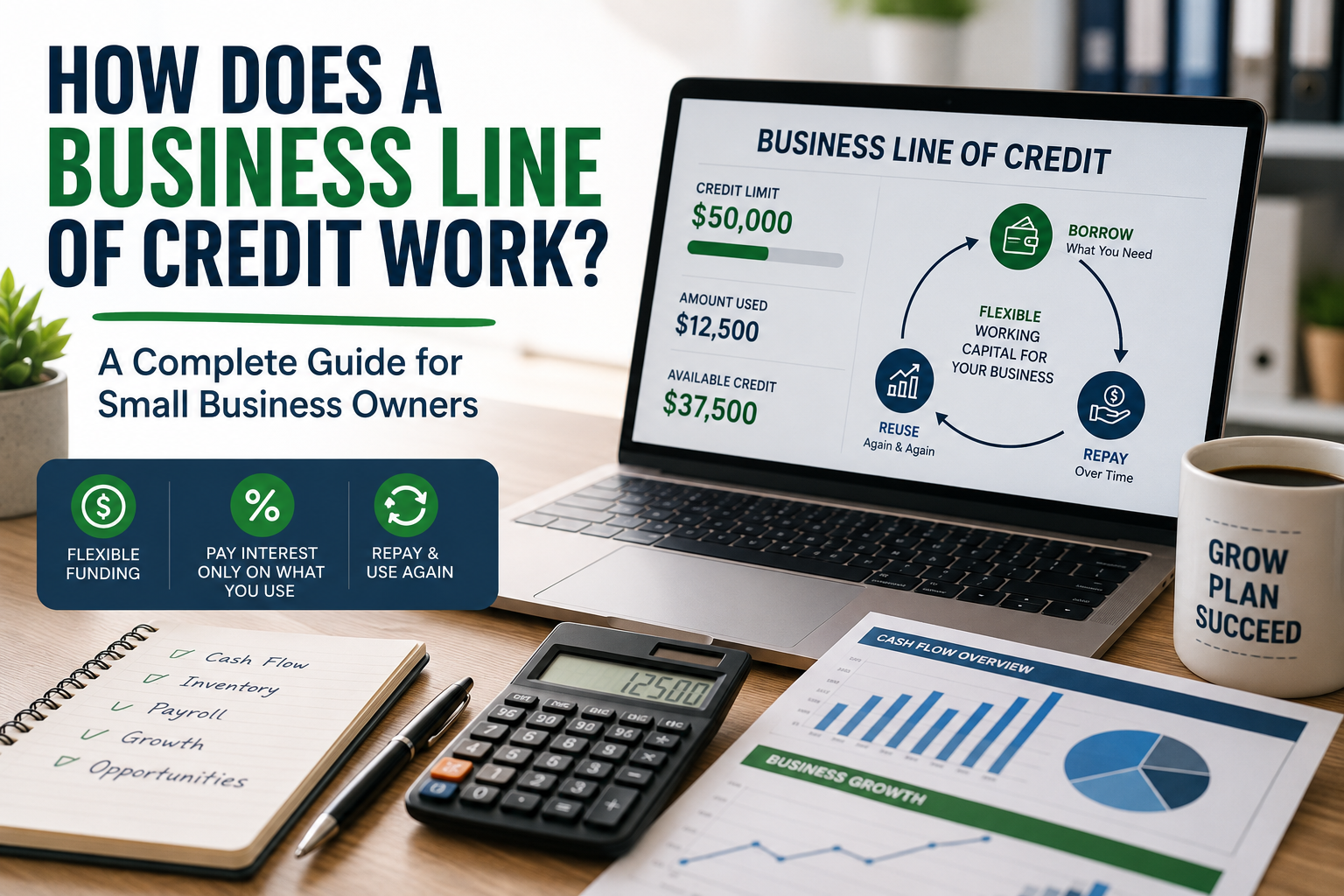
Starting or growing a business often requires access to capital. Whether you’re purchasing inventory, managing payroll, covering unexpected expenses, or investing in expansion, having flexible financing can make all the difference. This is where a business line of credit becomes one of the most useful financial tools available to entrepreneurs.
Unlike a traditional business loan that provides a lump sum upfront, a business line of credit allows you to borrow only what you need, when you need it. You pay interest only on the amount you use, making it a flexible option for managing short-term cash flow.
But many business owners still ask the same question:
How does a business line of credit work?
In this comprehensive guide, you’ll learn exactly how it works, who qualifies, how repayment works, the different types available, and whether it’s the right financing option for your business.
More Read

What Is a Business Line of Credit?
A business line of credit is a revolving credit account provided by a bank, online lender, or credit union. It works similarly to a credit card but is designed specifically for business expenses.
Once approved, the lender gives your business a maximum borrowing limit.
For example:
More Read

- Credit Limit: $50,000
- Amount Borrowed: $8,000
- Remaining Available Credit: $42,000
You can withdraw funds whenever needed until you reach your approved limit.
The biggest advantage is flexibility—you aren’t required to borrow the full amount immediately.
Instead, you decide when and how much money to use.
Businesses looking for official financing programs can also explore the Small Business Administration financing resources.
How Does a Business Line of Credit Work?
A business line of credit follows a revolving borrowing model.
Here’s how the process typically works.
Step 1: Apply for Credit
The lender reviews your business based on several factors, including:
More Read

- Annual revenue
- Time in business
- Personal credit score
- Business credit history
- Cash flow
- Existing debt
If approved, you’ll receive a borrowing limit.
Example:
Approved Credit Limit = $30,000
Step 2: Borrow Only What You Need
Instead of receiving the full $30,000, you may only borrow:
- $5,000 for inventory
- $2,500 for payroll
- $3,000 for equipment repairs
Total borrowed:
$10,500
The remaining balance stays available whenever you need additional funds.
Step 3: Pay Interest Only on the Borrowed Amount
One of the biggest benefits is that interest is usually charged only on the money you actually use—not your total credit limit.
Example:
Credit Limit:
$30,000
Borrowed:
$8,000
Interest applies only to the $8,000, not the remaining unused credit.
This makes it more cost-effective than borrowing a large lump sum you don’t immediately need.
Step 4: Make Repayments
Depending on the lender, repayments may be:
- Weekly
- Bi-weekly
- Monthly
Payments generally include:
- Principal
- Interest
- Applicable fees (if any)
Many lenders allow early repayment without penalties, though terms vary.
Step 5: Reuse Your Credit
This is what makes it revolving credit.
Suppose:
Credit Limit = $40,000
You borrow:
$12,000
Later, you repay:
$8,000
Your available credit increases again.
Available Credit:
$36,000
You can borrow again without submitting a new application, as long as your account remains in good standing.
Example: How a Business Line of Credit Works
Imagine you own a small online clothing store.
Sales increase during the holiday season, and you need additional inventory before customers place orders.
Instead of taking out a large business loan, you use your business line of credit.
Here’s what happens:
- Credit Limit: $60,000
- Inventory Purchase: $15,000
- Interest Charged Only on: $15,000
- Holiday Sales Generate Profit
- You Repay the Borrowed Amount
- Your Available Credit Returns
Now, if another opportunity arises, you can borrow again without applying for new financing.
This flexibility is one of the main reasons many small businesses prefer a line of credit over a traditional loan.
When Should You Use a Business Line of Credit?
A business line of credit is best suited for recurring or short-term financing needs rather than major long-term investments.
It can be especially useful when you need to:
- Cover temporary cash flow gaps
- Purchase seasonal inventory
- Manage payroll during slower months
- Pay suppliers before customer payments arrive
- Handle emergency repairs or unexpected expenses
- Finance short-term marketing campaigns
- Take advantage of limited-time business opportunities
Because you only borrow what you need, it offers greater flexibility than many fixed-term financing options.
Types of Business Lines of Credit, Secured vs. Unsecured, and Business Line of Credit vs. Business Loan
Now that you understand how a business line of credit works, it’s important to know that not all lines of credit are the same. Lenders offer different options based on your business’s financial health, available collateral, and funding needs.
Choosing the right type of credit can help you save money on interest, improve cash flow, and avoid unnecessary borrowing costs.
Types of Business Lines of Credit
Most lenders offer two primary types of business lines of credit: secured and unsecured. Both serve the same purpose but differ in approval requirements, borrowing limits, and interest rates.
1. Secured Business Line of Credit
A secured business line of credit requires you to pledge an asset as collateral. This collateral reduces the lender’s risk, making it easier to qualify for larger credit limits and lower interest rates.
Common collateral includes:
- Business equipment
- Commercial property
- Inventory
- Accounts receivable
- Business savings accounts
Advantages
- Higher borrowing limits
- Lower interest rates
- Easier approval for newer businesses
- Better repayment terms
Disadvantages
- Your collateral is at risk if you fail to repay.
- The approval process may take longer because the lender needs to evaluate the pledged assets.
Best for: Businesses planning large purchases or requiring ongoing access to substantial working capital.
2. Unsecured Business Line of Credit
An unsecured business line of credit does not require physical collateral. Instead, lenders evaluate your business’s financial strength, credit history, revenue, and cash flow.
Because there’s no collateral involved, these credit lines generally have:
- Smaller borrowing limits
- Higher interest rates
- Stricter approval requirements
Advantages
- No business assets are pledged.
- Faster approval process.
- Easier access to emergency funding.
Disadvantages
- Lower credit limits.
- Higher borrowing costs.
- Strong credit history is usually required.
Best for: Established businesses with healthy revenue and excellent credit profiles.
Secured vs. Unsecured Business Line of Credit
Choosing between these two options depends on your business goals and financial situation.
| Feature | Secured Line of Credit | Unsecured Line of Credit |
|---|---|---|
| Collateral Required | Yes | No |
| Interest Rates | Lower | Higher |
| Credit Limit | Usually Higher | Usually Lower |
| Approval Difficulty | Easier | More Difficult |
| Risk to Business Assets | Yes | No |
| Best For | Growing businesses needing larger funding | Businesses with strong credit seeking flexibility |
If your company owns valuable assets and wants lower borrowing costs, a secured line of credit may be the better choice. On the other hand, businesses that prefer not to risk assets may find an unsecured line of credit more suitable, even if it comes with higher interest rates.
Business Line of Credit vs. Business Loan
Many business owners confuse a business line of credit with a traditional business loan. While both provide financing, they work very differently.
A business loan gives you a lump sum upfront. You begin repaying the full amount immediately through fixed monthly payments over a predetermined period.
A business line of credit, however, provides access to a revolving pool of funds. You borrow only what you need and pay interest only on the amount you use.
This flexibility makes a line of credit ideal for managing recurring expenses and seasonal cash flow fluctuations.
Comparison Table
| Feature | Business Line of Credit | Business Loan |
|---|---|---|
| Funding | Borrow as needed | Lump sum payment |
| Interest | Only on borrowed amount | Entire loan amount |
| Repayment | Revolving | Fixed schedule |
| Reuse of Funds | Yes | No |
| Best For | Cash flow, payroll, inventory | Equipment, expansion, real estate |
| Flexibility | High | Moderate |
Which Option Is Better?
The answer depends on why you need financing.
Choose a Business Line of Credit if you want to:
- Cover short-term expenses.
- Manage seasonal cash flow.
- Purchase inventory throughout the year.
- Handle unexpected emergencies.
- Maintain ongoing financial flexibility.
Choose a Business Loan if you want to:
- Buy commercial property.
- Expand to a new location.
- Purchase expensive machinery.
- Finance long-term business growth.
- Invest in large infrastructure projects.
Neither option is universally better. The right choice depends on your business objectives, repayment capacity, and financing needs.
Can You Have Both?
Yes. Many successful businesses use both financing options strategically.
For example:
A manufacturing company may use:
- A business loan to purchase new production equipment.
- A business line of credit to pay suppliers, cover payroll, and manage day-to-day operating expenses.
This combination allows businesses to separate long-term investments from short-term working capital needs, improving financial flexibility and cash flow management.
Expert Tip
One common mistake small business owners make is using a business line of credit for long-term investments.
Since lines of credit often have variable interest rates and are designed for short-term borrowing, financing multi-year projects with them can become expensive.
Instead, use:
- Business Line of Credit → Working capital and operational expenses.
- Business Loan → Long-term investments and major business expansion.
This approach helps reduce borrowing costs while keeping your finances more manageable.
Eligibility Requirements, Interest Rates, Pros & Cons, and Real-World Example
Choosing the right financing option starts with understanding whether your business qualifies. While approval requirements vary by lender, most banks and online financial institutions evaluate similar factors before granting a business line of credit.
Knowing these requirements in advance can improve your approval chances and help you secure better terms.
Understanding your business credit profile is important. Read more about Business credit scores explained.
Who Can Qualify for a Business Line of Credit?
Most lenders assess the overall financial health of your business before approving a credit line.
The following factors usually play the biggest role.
1. Business Revenue
Lenders want proof that your business generates enough income to repay borrowed funds.
Many traditional banks prefer businesses with annual revenue of $100,000 or more, although some online lenders accept lower revenue requirements.
Higher and more consistent revenue generally improves your chances of approval and may qualify you for a larger credit limit.
2. Time in Business
Businesses that have been operating longer are often viewed as lower-risk borrowers.
Typical requirements include:
- Online lenders: 6–12 months
- Banks: 2 years or more
New businesses can still qualify, but they may receive lower limits or higher interest rates.
3. Credit Score
Your personal credit score—and sometimes your business credit score—is one of the most important factors.
A stronger score signals responsible financial management.
General Guidelines
| Credit Score | Approval Chances |
|---|---|
| 750+ | Excellent |
| 700–749 | Very Good |
| 650–699 | Good |
| 600–649 | Limited Options |
| Below 600 | Difficult, but not impossible |
Even if your score isn’t perfect, strong revenue and positive cash flow can strengthen your application.
4. Cash Flow
Lenders don’t just look at total revenue—they also evaluate how consistently money flows into your business.
Businesses with stable monthly income are generally seen as lower risk because they are more likely to make repayments on time.
Poor cash flow, even with high revenue, may reduce your chances of approval.
5. Existing Debt
If your business already has multiple loans or a high debt-to-income ratio, lenders may hesitate to extend additional credit.
Reducing existing debt before applying can improve both your approval odds and borrowing terms.
Documents You May Need
Although requirements vary by lender, applicants are often asked to provide:
- Government-issued identification
- Business registration documents
- Employer Identification Number (EIN) or Tax ID
- Business bank statements
- Recent tax returns
- Profit and loss statement
- Balance sheet
- Cash flow statement
Having these documents ready can speed up the application process.
How Interest Rates Work
One of the most common questions business owners ask is:
How much does a business line of credit cost?
The answer depends on your lender, credit profile, and whether the credit line is secured or unsecured.
Interest is typically charged only on the amount you borrow, not on your total credit limit.
Example
Approved Credit Limit:
$50,000
Amount Used:
$12,000
Interest is calculated only on the $12,000 balance, while the remaining $38,000 stays available for future use.
This is one of the biggest advantages of a business line of credit over many traditional loans.
Additional Fees to Watch For
Besides interest, some lenders may charge additional fees, such as:
- Annual maintenance fee
- Draw fee (each time you withdraw funds)
- Account maintenance fee
- Late payment fee
- Origination fee
- Inactivity fee
Before accepting an offer, always review the lender’s fee structure—not just the advertised interest rate.
A lower interest rate can still become expensive if hidden fees are high.
Real-World Example
Imagine Sarah owns a growing digital marketing agency.
Several clients delay their payments, but payroll is due at the end of the month.
Instead of taking out a large business loan, Sarah uses her $40,000 business line of credit.
She withdraws $10,000 to cover payroll and operating expenses.
Three weeks later, client payments arrive, and she repays the borrowed amount.
Because she borrowed only $10,000, she pays interest only on that amount—not on the full $40,000 credit limit.
The remaining credit stays available for future business needs.
This flexibility helps businesses navigate temporary cash-flow challenges without taking on unnecessary long-term debt.
Advantages of a Business Line of Credit
Many entrepreneurs choose this financing option because it offers flexibility and control.
Key Benefits
Flexible Access to Funds
Borrow only what you need, when you need it.
Interest Only on Used Funds
Unlike traditional loans, you generally pay interest only on the amount you’ve drawn.
Improves Cash Flow
A business line of credit can help bridge gaps between incoming customer payments and outgoing business expenses.
Reusable Credit
As you repay borrowed funds, your available credit is restored, allowing you to borrow again without reapplying.
Supports Business Growth
Whether purchasing inventory, launching a marketing campaign, or covering seasonal demand, a line of credit provides quick access to working capital.
Disadvantages of a Business Line of Credit
Despite its benefits, this financing option isn’t suitable for every situation.
Variable Interest Rates
Many business lines of credit have variable rates, meaning borrowing costs can increase if market interest rates rise.
Overspending Risk
Easy access to funds can tempt some businesses to borrow more than necessary, leading to unnecessary debt.
Lower Credit Limits for New Businesses
Startups and businesses with limited credit history may receive smaller borrowing limits.
Fees Can Add Up
Annual fees, draw fees, and maintenance charges can increase the overall cost if not carefully managed.
Approval Isn’t Guaranteed
Businesses with poor credit, inconsistent revenue, or limited operating history may find it difficult to qualify through traditional lenders.
Common Mistakes Business Owners Should Avoid
Even experienced entrepreneurs sometimes misuse a business line of credit.
Avoid these common mistakes:
Using It for Long-Term Investments
A business line of credit is best for short-term working capital—not purchasing real estate or financing multi-year expansion projects.
Borrowing the Full Credit Limit Immediately
Just because you have access to a certain amount doesn’t mean you should use it all.
Borrow only what your business genuinely needs.
Missing Payments
Late payments can damage your business credit profile, increase borrowing costs, and reduce your chances of qualifying for future financing.
Ignoring Fees
Always read the full agreement. Low advertised interest rates don’t always reflect the total cost of borrowing.
Not Comparing Lenders
Interest rates, fees, repayment terms, and credit limits vary widely.
Comparing multiple lenders can help you find the most cost-effective option for your business.
Frequently Asked Questions
What is a business line of credit?
A business line of credit is a revolving financing option that allows businesses to borrow money up to a pre-approved limit. You only pay interest on the amount you use, and once you repay the borrowed funds, the credit becomes available again.
How does a business line of credit work?
After approval, the lender assigns your business a maximum credit limit. You can withdraw funds whenever needed, repay the borrowed amount over time, and borrow again without submitting a new application—as long as your account remains in good standing.
Is a business line of credit better than a business loan?
It depends on your needs.
A business line of credit is ideal for short-term expenses, managing cash flow, or handling seasonal business needs.
A business loan is usually better for long-term investments, purchasing equipment, or financing major business expansion.
Do you pay interest on the entire credit limit?
No.
Most lenders charge interest only on the amount you actually borrow—not on your full approved credit limit.
What credit score is needed for a business line of credit?
Requirements vary by lender, but many traditional lenders prefer a personal credit score of 680 or higher. Some online lenders may approve applicants with lower scores if the business has strong revenue and healthy cash flow.
Can startups qualify for a business line of credit?
Yes, but approval can be more challenging. Startups often need to demonstrate strong financial projections, personal creditworthiness, or provide collateral to improve their chances of approval.
How long does approval take?
Approval times depend on the lender.
- Online lenders may provide a decision within 24–72 hours.
- Traditional banks can take several days to a few weeks, especially if additional documentation is required.
Final Verdict
A business line of credit is one of the most flexible financing tools available to small business owners. Unlike a traditional loan, it gives you ongoing access to funds while allowing you to pay interest only on the amount you actually use.
This makes it especially useful for:
- Managing cash flow
- Purchasing inventory
- Covering payroll
- Handling unexpected expenses
- Funding short-term business opportunities
However, it should be used responsibly. Borrow only what your business truly needs, make repayments on time, and compare lenders carefully before signing an agreement.
If your goal is to finance a major long-term investment, a traditional business loan may be the better choice. But for day-to-day flexibility and working capital, a business line of credit is often the smarter solution.
By understanding how it works and choosing the right lender, you can use this financing option to support growth while maintaining healthy financial management.