

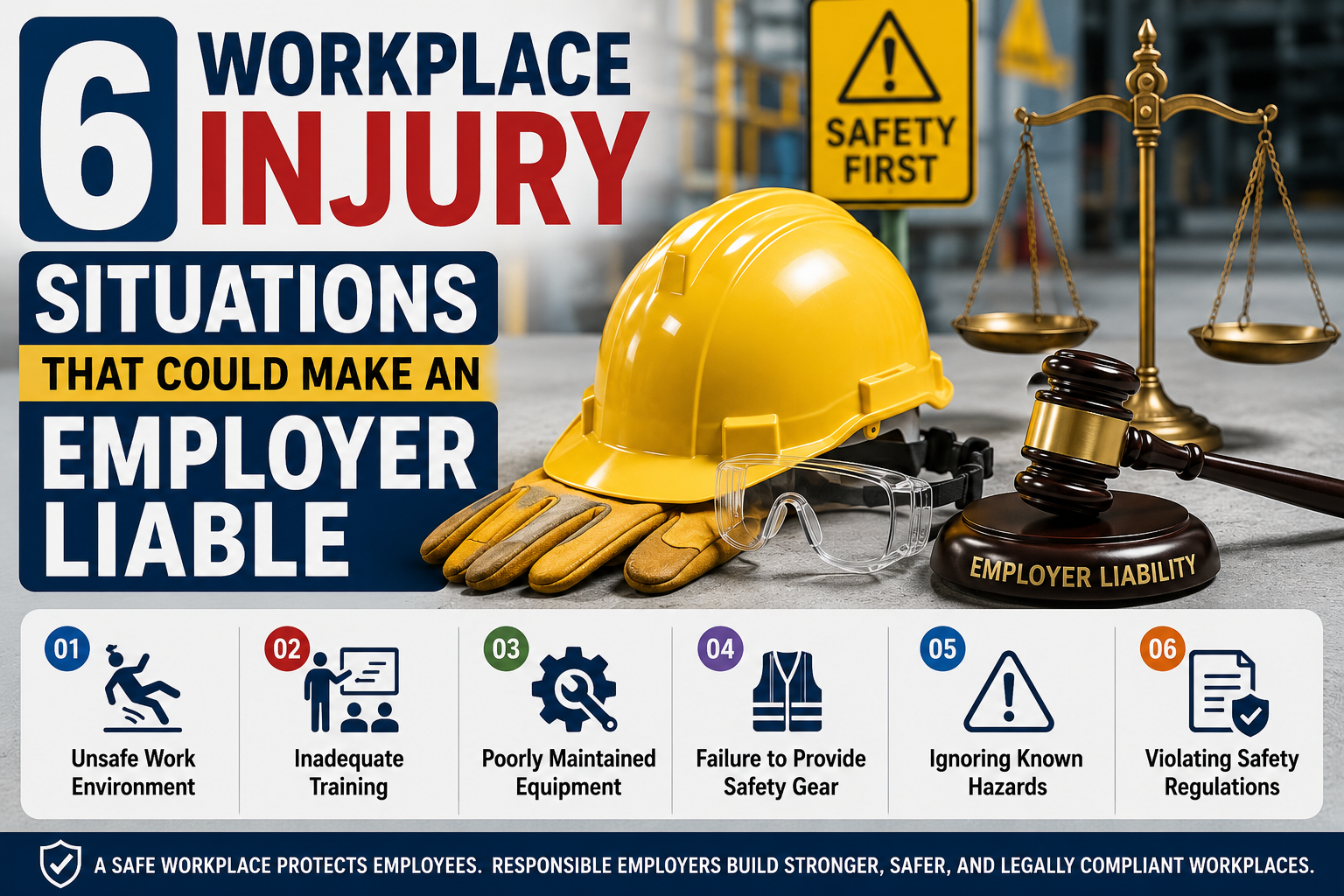
Workplace Injury Employer Liability: 6 Situations That Could Make an Employer Liable
Workplace accidents can happen in almost any industry, but not every injury automatically makes an employer legally responsible. Workplace Injury Employer Liability refers to situations where an employer may be held accountable because they failed to provide a reasonably safe working environment, ignored safety regulations, or neglected important responsibilities. Understanding these situations helps employees know their rights while encouraging employers to create safer workplaces.
This article explains six common situations that could lead to employer liability, how investigators determine responsibility, the difference between employer liability and workers’ compensation, and practical steps that help prevent workplace injuries.
Legal Disclaimer: This article is for educational purposes only and does not constitute legal advice. Employment and workplace injury laws differ between countries and states. Always consult a qualified attorney or the relevant labor authority regarding your specific circumstances.
What Is Workplace Injury Employer Liability?
Workplace Injury Employer Liability is the legal responsibility an employer may have when an employee suffers an injury because the employer failed to meet their duty of care.
Every employer has a responsibility to provide a workplace that is reasonably safe. This includes maintaining equipment, correcting known hazards, providing proper training, and following workplace safety regulations.
However, employer liability is not automatic. Investigators typically examine whether the employer acted reasonably to prevent foreseeable risks.

Several factors influence liability, including:
- Workplace safety procedures
- Employee training records
- Equipment maintenance history
- Safety inspections
- Compliance with occupational safety regulations
- Actions taken after hazards were reported
When these responsibilities are ignored, employer liability becomes more likely.
Why Workplace Injury Employer Liability Matters
Understanding Workplace Injury Employer Liability benefits both employers and employees.

For employees, it helps them understand:
- Their right to a safe workplace
- Why safety procedures exist
- What information should be documented after an accident
- When legal responsibility may become an issue
For employers, understanding liability encourages:
- Better risk management
- Fewer workplace injuries
- Improved employee confidence
- Lower insurance costs
- Stronger legal compliance
Preventing injuries is always less costly than dealing with the financial and legal consequences after an accident occurs.
How Employer Liability Is Different From Workers’ Compensation
One of the most misunderstood areas of employment law is the relationship between employer liability and workers’ compensation.
Although they are related, they serve different purposes.
| Workplace Injury Employer Liability | Workers’ Compensation |
|---|---|
| Based on negligence or legal responsibility | Usually provides benefits regardless of fault |
| May involve legal claims | Usually handled through insurance |
| Requires investigation into employer conduct | Focuses on medical expenses and wage replacement |
| May result in additional damages where permitted | Benefits are generally limited by law |
Many workplace injuries are covered through workers’ compensation without proving employer negligence. Employer liability generally becomes more important when there is evidence that safety responsibilities were ignored.

Situation 1: Failing to Maintain a Safe Workplace
The most common cause of Workplace Injury Employer Liability is failing to maintain safe working conditions.
Employers are expected to identify hazards before someone gets injured. When obvious dangers remain uncorrected, the risk of liability increases.
Examples include:
- Wet floors without warning signs
- Broken stair railings
- Damaged flooring
- Poor lighting
- Blocked emergency exits
- Exposed electrical wiring
- Unsafe storage areas
These hazards often remain visible for days or weeks before an accident happens. If management knew—or reasonably should have known—about the danger but failed to correct it, investigators may consider that evidence of negligence.
Why Prevention Matters
Regular workplace inspections often identify hazards before employees are exposed to unnecessary risks.
Many organizations reduce accident rates simply by conducting scheduled inspections and documenting repairs.
Situation 2: Inadequate Employee Training
Even modern equipment becomes dangerous when employees are not properly trained.
Training should cover far more than basic job duties. Workers also need to understand:
- Emergency procedures
- Hazard recognition
- Safe lifting techniques
- Machine operation
- Chemical handling
- Lockout/tagout procedures where applicable
- Personal protective equipment requirements
New employees face particularly high risks because they are unfamiliar with workplace hazards.
When an employer expects workers to perform hazardous tasks without adequate instruction, Workplace Injury Employer Liability becomes more likely if an accident occurs.
Common Example
Imagine a warehouse employee who receives only a brief orientation before operating a powered forklift.
If the employee causes an accident because proper training was never provided, investigators may examine whether the employer fulfilled their legal training obligations.
Training records often become important evidence during workplace investigations.
Situation 3: Poor Equipment Maintenance
Machines naturally wear down over time.
Employers are generally responsible for inspecting equipment regularly and repairing defects before employees are injured.
Examples include:
- Defective forklifts
- Broken ladders
- Faulty electrical tools
- Damaged safety harnesses
- Malfunctioning conveyor systems
- Worn machine guards
Ignoring maintenance schedules creates unnecessary risks.
A machine that appears functional may contain hidden mechanical problems capable of causing severe injuries.
Warning Signs Employers Should Never Ignore
Maintenance teams should investigate:
- Strange equipment noises
- Fluid leaks
- Broken safety switches
- Excessive vibration
- Electrical faults
- Missing guards
- Repeated operator complaints
Repairing equipment promptly protects employees while significantly reducing potential liability.
How Safety Documentation Can Protect Everyone
One topic many articles overlook is documentation.
Accurate records protect both employers and employees.
Useful documentation includes:
- Maintenance logs
- Safety inspection reports
- Employee training records
- Incident reports
- Hazard correction records
- Equipment inspection schedules
Documentation demonstrates that safety was actively managed rather than ignored.
Without written records, proving that proper precautions were taken becomes much more difficult.
Industries With Higher Workplace Injury Risks
Although accidents can occur anywhere, some industries naturally experience greater exposure to workplace hazards.
These include:
- Construction
- Manufacturing
- Warehousing
- Transportation
- Agriculture
- Healthcare
- Oil and gas
- Mining
- Food processing
Because these industries involve heavy equipment, hazardous materials, or physically demanding work, employers are generally expected to implement stronger safety programs and more frequent employee training.
Situation 4: Failure to Provide Proper Personal Protective Equipment (PPE)
Another major cause of Workplace Injury Employer Liability is failing to provide appropriate personal protective equipment (PPE). Many industries require employees to wear protective gear to reduce the risk of serious injuries. If employers do not supply the necessary equipment—or fail to enforce its use—they may increase their legal exposure when an accident occurs.
Common examples of PPE include:
- Safety helmets
- Safety goggles
- Hearing protection
- Protective gloves
- Steel-toe boots
- Respirators
- High-visibility clothing
- Fall-arrest harnesses
For example, if a construction company asks employees to work at height without approved fall-protection equipment, the employer could face significant legal consequences if a fall occurs.
Best Practices for Employers
Providing PPE is only the first step. Employers should also:
- Replace damaged equipment promptly.
- Train employees on correct usage.
- Inspect PPE regularly.
- Ensure protective gear meets current safety standards.
These actions not only improve safety but also demonstrate a commitment to compliance.
Situation 5: Ignoring Reported Workplace Hazards
Many workplace accidents are preventable because employees notice hazards before anyone gets hurt. Unfortunately, some employers delay taking action even after receiving multiple complaints.
Ignoring reported hazards is one of the clearest situations where Workplace Injury Employer Liability may arise.
Examples include:
- Loose flooring
- Faulty machinery
- Chemical leaks
- Broken handrails
- Unsafe storage of heavy materials
- Electrical hazards
If workers repeatedly report these dangers and management fails to investigate or correct them, an injury resulting from those hazards may lead to increased liability.
Why Reporting Systems Matter
Employers should encourage workers to report safety concerns without fear of retaliation. A simple reporting system can prevent injuries that might otherwise result in expensive legal disputes.
Situation 6: Violating Workplace Safety Regulations
Employers are generally required to follow occupational safety laws and industry-specific regulations. Ignoring these legal obligations may significantly increase the likelihood of Workplace Injury Employer Liability.
Examples of safety violations include:
- Missing machine guards
- Failure to inspect equipment
- Improper handling of hazardous chemicals
- Lack of fall protection
- Unsafe electrical systems
- Inadequate emergency exits
Regulatory violations do not automatically prove liability, but they may become strong evidence during investigations or legal proceedings.
Employers who maintain documented compliance programs are generally better prepared to demonstrate that reasonable safety measures were in place.
Common Misconceptions About Workplace Injury Employer Liability
Many people misunderstand how employer liability works. Clearing up these misconceptions helps employees and employers make informed decisions.
Every Workplace Injury Makes the Employer Liable
This is false. Many workplace injuries occur despite reasonable safety precautions. Liability usually depends on whether the employer failed to meet their legal duty of care.
Workers’ Compensation and Employer Liability Are the Same
Workers’ compensation is designed to provide benefits after work-related injuries, regardless of fault in many jurisdictions. Employer liability focuses on whether negligence or legal violations contributed to the accident.
Office Workers Face No Workplace Risks
Office environments can still present hazards such as slips, electrical accidents, repetitive strain injuries, and poor ergonomic setups.
How Investigators Determine Employer Liability
After a serious workplace accident, investigators often review multiple sources of evidence before deciding whether employer negligence contributed to the incident.
Typical evidence includes:
- Safety inspection reports
- Employee training records
- Maintenance logs
- Witness statements
- Photographs
- Incident reports
- Surveillance footage
- Previous safety complaints
- Regulatory inspection history
The investigation focuses on whether the employer took reasonable steps to identify and eliminate known risks before the injury occurred.
Practical Steps Employers Can Take to Reduce Liability
The best way to reduce Workplace Injury Employer Liability is to prevent accidents before they happen.
Recommended practices include:
- Conduct routine workplace safety inspections.
- Repair defective equipment immediately.
- Provide ongoing employee safety training.
- Keep maintenance records up to date.
- Supply certified personal protective equipment.
- Encourage employees to report hazards.
- Review emergency procedures regularly.
- Perform regular risk assessments.
- Investigate every workplace incident.
- Stay updated with applicable safety regulations.
A proactive safety culture benefits both employees and employers by reducing injuries, improving productivity, and lowering insurance costs.
An Often-Overlooked Factor: Safety Culture
One area many articles fail to discuss is workplace culture. Even companies with excellent written safety policies may experience preventable accidents if employees feel pressured to ignore those rules.
Signs of a healthy safety culture include:
- Management responds quickly to reported hazards.
- Employees receive refresher safety training.
- Supervisors lead by example.
- Safety concerns are taken seriously.
- Workers are never discouraged from reporting incidents.
A positive safety culture often prevents accidents long before legal liability becomes an issue.
Frequently Asked Questions
1. What is Workplace Injury Employer Liability?
Workplace Injury Employer Liability refers to the legal responsibility an employer may have when an employee is injured because reasonable workplace safety measures were not provided or legal duties were neglected.
2. Can an employer be liable even if workers’ compensation is available?
Yes. Depending on the laws in a particular jurisdiction, employer liability may still arise if negligence, intentional misconduct, or serious safety violations contributed to the injury.
3. What evidence helps prove employer liability?
Important evidence may include maintenance records, training documentation, witness statements, photographs, medical reports, inspection records, and previous reports of workplace hazards.
4. Are remote employees covered by workplace injury laws?
In some jurisdictions, injuries sustained while performing authorized work duties from home may qualify as workplace injuries. Coverage depends on local laws and the specific facts of the case.
5. Which industries have the highest workplace injury rates?
Construction, manufacturing, transportation, agriculture, healthcare, warehousing, mining, and oil and gas industries generally face higher workplace injury risks because of hazardous working conditions.
6. How can employers reduce workplace injury claims?
Employers can reduce claims by maintaining equipment, providing proper training, supplying PPE, conducting inspections, documenting safety procedures, and addressing reported hazards promptly.
7. Should an injured employee consult a lawyer?
If an injury is serious, benefits are denied, or liability is disputed, consulting a qualified employment or personal injury lawyer can help explain legal rights and available options.
Conclusion
Understanding Workplace Injury Employer Liability is essential for both employers and employees. Safe workplaces depend on proper training, routine equipment maintenance, hazard reporting, compliance with safety regulations, and a strong commitment to prevention. While not every workplace injury results in employer liability, situations involving unsafe conditions, ignored hazards, inadequate training, missing protective equipment, or regulatory violations can increase legal responsibility. By prioritizing workplace safety and maintaining clear documentation, organizations can reduce accidents while protecting both their workforce and their business.